
Democratic Evolution or Virtual Civil WarRemarks as prepared by Steven Clift for the Promise of E-Democracy WSIS Event, Geneva, Switzerland, December 2003
Event information from: http://egov.unitar.org/spip/article169.html
Event video from: http://egov.unitar.org/spip/article187.html
Watch my speech in Real Video(Due to time constraints, I saved some of my prepared text below for the lively discussion.)
Join the revolution?
I don’t believe the Internet is inherently democratic. To me, most people and organizations are fundamentally anti-democratic by nature. Many of those in power and those clamoring for power are self-centered actors. They operate within the miracle we call representative democracy. Most accept the idea that democracy is good, but these actors do little to ensure its strength.
After a decade working directly with e-democracy issues, I’ve concluded that “politics as usual” online may be the tipping point that finishes off what television started – the extinction of democracy and democratic spirit.
Those hoping for an almost accidental democratic transformation fostered by the information technology will watch in shock from the sidelines as their favorite new medium becomes the arsenal of virtual civil war – virtual civil wars among partisans at all levels.
When I open e-mail from all sorts of American political parties and activist groups, I see conflict. I see unwillingness to compromise.
Let’s be optimists and suggest that the Net is doubling the activist population from five percent to ten percent. The harsh reality is that we are doubling the virtual soldiers, an expendable slash and burn online force, available to established political interests.
As the excessive and bitter partisanship of the increased activist population leaks into the e-mail boxes of everyday people, I predict abhorrence of Net-era politics among the general citizenry. I fear the extreme erosion of public trust not just in government, but also in most things public and political.
Instead of encouraging networked citizen participation that improves the public results delivered in our democracies, left to its natural path, the Internet will be used to eliminate forms of constructive civic engagement by the other 90 percent of citizens. A 10 percent democracy of warring partisan is no democracy at all.
Compounding the problem, the billions of Euros in e-government focus almost exclusively on one-way services and efficiency. Government makes it easy to pay your taxes online – while doing little to give you a virtual – anytime, anywhere – say in how those taxes are spent. Many elected officials are turning off their e-mail for citizens, leaving it on for lobbyists to reach their staff directly, and building what I call “Digital Berlin Walls” of complicated web forms. One-way “e-governments” based on efficiency to the exclusion of “two-way” democracy are the norm. Unfortunately, most governments are saying e-services first, democracy later.
In summary, online political strife combined with governments that are incapable of accommodating our public will present a dark future for democracy in the information age.
Join the democratic evolution!
Everything I’ve just said contrasts dramatically from the exceptional experiences of citizen groups and governments leading the way with the best e-democracy practices.
Everyday in Minnesota, I experience the power of online discourse among citizens. I am impressed by online innovations in many parliaments and government agencies. And I’ve been inspired by the online activism of many groups.
However, we have an enemy. It is not “politics as usual.” They must compete to survive. Our enemy is our indifference to our generational democratic obligations. We have a duty to make the most honorable use of the unique information age opportunities before us.
We have a choice, we can strategically use ICTs to improve our communities, strengthen society, and address global challenges or we can ride the ICT-accelerated race to the post-democratic bottom.
It is time to give more than lip service to e-democracy experiments, research, and best practices.
It is time to bring the democratic intent and values required to make the demonstrated possibility of the new online medium a universal reality.
Build the democratic evolution!
To make what is possible probable, the time for action has arrived.
The new media, led by the Internet, must be used to help us meet public challenges. It must be used to transform anti-democratic states and break apart hyper-partisan and unresponsive politics at all levels. We must be smarter, faster, and more committed than “politics as usual.”
How? In the next decade, I ask you to join me in three specific campaigns.
1. The Rule of Law – Mandate the democratic evolution!
By making exceptional and essential e-democracy best practices universal through the rule of law.
We know most of what works, the technology exists, and great examples abound. Nothing optional in government will become universal or wide spread if it remains unfunded or a choice.
Laws must be passed to require that:
A. By 2005 all public meeting notices with agendas and legally public meeting documents must be posted online not just on a cork board in some government office. No electronic notice, no meeting.
B. By 2006 all representative and regulatory bodies must make all proposed legislation and amendments available online the second it is distributed as a public document to anyone. Once passed, no law, rule, regulation, and budget details not freely available online should be considered enforceable. No transparency … then no authority and no money.
C. Next, citizens have a right to be notified via e-mail about new government information based on their interests and where they live. Timely notification allows people to act politically when it still matters. Governments must fund and implement such systems. Maintaining garbage dumps of government data is choice against openness and accountability. Any government in a OECD country without an online personalization and notification system by mid-2006 will be added to my list of anti-e-democratic governments.
D. By 2007 citizens need access to complete, always up-to-date, local “MyDemocracy” directories of all their elected officials and government organizations. No contact data, no power. A global network of these standardized and networked databases will be a tool from which we can build 21st century democracy.
Remember, we must develop and pass laws that require these things to happen. I see no short cut without resources and legal mandates from our elected officials.
2. Public Net-Work – Leverage the evolution!
By building the online infrastructure to help citizens and their governments meet public challenges through a new concept I call “public net-work.”
If e-democracy is primarily about input into government decision-making, “Public Net-Work” is about stakeholder and citizen involvement in the implementation of established government priorities. Leading governments are moving from sole providers to facilitators of those who want to roll up their “virtual” sleeves and solve similar problems. Think e-volunteerism instead of e-consultation.
The few Public Net-Work projects, like Community Builders New South Wales and the downtown community policing efforts in Minneapolis, use many of the same online tools we need for e-democracy. E-democracy technology investments are really a two for one opportunity – better input and effective output in the public interest.
3. Online Public Issue Forums – Localize the democratic evolution!
We must establish two-way citizen-based e-democracy forums in every locality and connect them with one another on a national and global basis.
When I travel through a town, I always envision the community bonds among people and think about how the online world might help reconnect neighbors and communities.
In 1994, E-Democracy.Org built the world’s first election-oriented web site. More importantly we built an online forum where Minnesotans -from across the political spectrum- could discuss real public issues. We turned the once a year in-person town hall meeting into a 24 hours a day, seven days a week, 365 days a year online civic event.
In 1998 we took our model local. In Minneapolis, St. Paul, and Winona we use e-mail, the tool of choice among most people online, to facilitate many-to-many discussions. We build public space online that has agenda-setting power in real community. These forums work. They work well. I cannot imagine my local democracy without one. What about your local democracy?
Citizens cannot wait for governments to build or fund these forums. By volunteering and working to pragmatically recruit the participation of elected officials, community leaders, and journalists they will attract diverse citizens and new voices rarely heard in traditional time and place discriminatory forms of democracy.
On the other hand, governments, media organizations, and civil society groups cannot wait for spontaneous citizen-led e-democracy activity. They need to join together and foster new local democratic institutions “of” the Internet and not just “on” the Internet. Like the creation of public broadcasting by past generations, something new must be created for the public benefit based on the democratic opportunity presented by new technologies.
Whether started by unaffiliated citizens or fostered by those on the inside who see the big e- democracy picture, an option you can take home is the opportunity to establish a local E-Democracy.Org chapter with an effective online forum “of, for and by” your community.
Long Live The Evolution!
What is possible with e-democracy is not probable unless we make it happen. Our opportunity to use these tools to raise the voice of citizens, improve representative democracy, and solve public problems is tremendous. And, what currently appears likely is not democratically desirable, unless we, unless we build online public spaces and democratic opportunities online from the center that bring people together and build the democratic evolution.
Yearly Archives: 2003
E-Democracy, E-Governance and Public Net-Work (Government 2.0) – Overview – By Steven Clift – 2003
E-Democracy, E-Governance and Public Net-Work
By Steven Clift
Version 1.1, September 2003
My Related Articles:
- Public Net-work: Online Information Exchange in the Pursuit of Public Service Goals (Word) – Commissioned by the OECD
- E-Government and Democracy – 40 Page Report – Commissioned by the United Nations
2009 Note: Before the term Gov 2.0 or Government 2.0 emerged I tried to introduce the concept of “public net-work.” The term didn’t stick, but the concept is rising.
Introduction
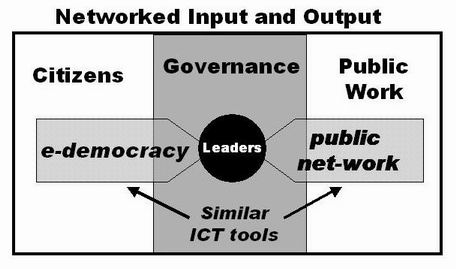
While the art and practice of government policy-making, citizen participation, and public work is quite complex, the following illustration provides a simple framework used in this paper:

In this model of traditional government policy-making:
1. Citizens provide occasional input between elections and pay taxes.
2. Power in the Governance infrastructure is centered with political leaders who determine broad policy priorities and distribute resources based on those priorities and existing programs and legal requirements.
3. Through government directly, and other publicly funded organizations, Public Work represents the implementation of the policy agenda and law.
Over time of course, bureaucratic barriers to reform make it difficult for leaders to recognize changes in citizen needs and priorities. Citizen input, outside of elections, often has a difficult time getting through. Disconnects among citizens, leaders, and those who implement public work are often based on the inability to easily communicate through and across these groups.
As our one-way broadcast world becomes increasingly two-way, will the governance process gain the ability to listen and respond more effectively?
The information-age, led by Internet content, software, technology, and connectivity, is changing society and the way we can best meet public challenges. E-democracy, e-governance, and public net-work are three interrelated concepts that will help us map out our opportunity to more effectively participate, govern, and do public work.
E-Democracy
E-democracy is a term that elicits a wide range of reactions. Is it part of an inevitable technology driven revolution? Will it bring about direct voting on every issue under the sun via the Internet? Is this just a lot of hype? And so on. (The answers … no, no, and no.)
Just as there are many different definitions of democracy and many more operating practices, e-democracy as a concept is easily lost in the clouds. Developing a practical definition of E-Democracy is essential to help us sustain and adapt everyday representative democratic governance in the information age.
Definition
After a decade of involvement in this field, I have established the following working definition:
E-Democracy is the use of information and communications technologies and strategies by “democratic sectors” within the political processes of local communities, states/regions, nations and on the global stage.
The “democratic sectors” include the following democratic actors:
-
- Governments
- Elected officials
- Media (and major online Portals)
- Political parties and interest groups
- Civil society organizations
- International governmental organizations
- Citizens/voters
- Governments
Current E-Democracy Activities
Each sector often views its new online developments in isolation. They are relatively unaware of the online activities of the other sectors. Those working to use information and communication technologies (ICTs) to improve or enhance democratic practices are finding e-democracy a lot more challenging to implement than speculating on its potential. This is why it is essential for the best e-democracy lessons and practices to be documented and shared.
This simplified model illustrates e-democracy activities as a whole. Building on the first diagram it, sits as a filter on the “input” border between citizens and governance in first diagram:

Governments provide extensive access to information and interact electronically with citizens, political groups run online advocacy campaigns and political parties campaign online, and the media and portal/search sites play a crucial role in providing news and online navigation. In this model, the “Private Sector” represents commercially driven connectivity, software, and technology. This is the whole of e-democracy.
E-democracy is not evolving in a vacuum with these sectors only. Technology enhancements and online trends from all corners of the Internet are continuously being adopted and adapted for political and governance purposes. This is one of the more exciting opportunities as e-mail, wireless networking, personalization, weblogs, and other tools move in from other online content, commerce, and technology areas and bring innovation and the opportunity for change with them.
Looking to the center of model, the only ones who experience “e-democracy” as a whole are “citizens.” In more “wired” countries most citizens are experiencing information-age democracy as “e-citizens” at some level of governance and public life. In developing countries, e-democracy is just as important, but exists as more of an institution-to-institution relationship. In all countries, the influence of “e-democracy” actually reaches most of the public through its influence on the traditional media and through word of mouth via influential members of the community.
“E-Citizens” – Greater Citizen Participation?
To many, e-democracy suggests greater and more active citizen participation enabled by the Internet, mobile communications, and other technologies in today’s representative democracy. It also suggests a different role for government and more participatory forms of direct citizen involvement in efforts to address public challenges. (Think e-volunteerism over e-voting.)
Some take this further and view the information revolution as an inherently democratic “disruptive technology” that will dramatically change politics for the better. This view has diminished considerably, as existing democratic actors have demonstrated their ability to incorporate new technologies and online communication strategies into their own activities and protect their existing interests. They have to in order to survive.
In the future, most “e-democracy” development will naturally result from ICT-accelerated competition among the various political forces in society. We are experiencing a dramatic “e-democracy evolution.” In this evolution, the role, interests, and the current and future activities of all actors is not yet well understood. There is still an opportunity to influence its development for the better.
Things will change, but as each democratic sector advances their online activities, democratic intent will be required to achieve the greater goals of democracy.
Related resources:
E-Democracy Resource Links Future of E-Democracy – The Fifty Year Plan E-Democracy E-Book: Democracy is Online 2.0
E-Governance
I use the phrase “Representative E-Government” to describe the e-democracy activities of government institutions. Others call this “e-governance.” Whether a local government or a United Nations agency, government institutions are making significant investments in the use of ICTs in their work. They are expressing “democratic intent.” Their efforts make this one of the most dynamic and important areas of e-democracy development.
There are distinct differences in how representative institutions and elected officials use ICTs compared to administrative agencies and departments. The use of ICTs by parliaments, heads of state/government, and local councils (and elected officials in these institutions) lags significantly behind the administrative-based e-government service and portal efforts. This is a services first, democracy later approach.
This focus of e-government resources on services does not mean that e-democracy is not gaining increased attention in some governments. In fact, leading e-service governments are now at a point where they are exploring their e-democracy responsibilities more seriously.
Goals for E-Democracy in Governance
Investment in traditional e-government service delivery is justified based on the provision of greater citizen convenience and the often-elusive goal of cost-savings. Goals for e-government in governance that promote democracy and effective governance include:
1. Improved government decisions2. Increased citizen trust in government
3. Increased government accountability and transparency
4. Ability to accommodate the public will in the information-age
5. To effectively involve stakeholders, including NGOs, business, and interested citizen in new ways of meeting public challenges (see public net-work below)
Consultation Online
The first area of government e-democracy exploration has focused on consultation within executive policy-making processes. Governments, like the United Kingdom and Canada, are taking their consultative frameworks and adapting them to the online environment. New Zealand and Canada now have special portals dedicated to promote the open consultations across their governments. This includes traditional off-line opportunities as well as those where online input is encouraged. Across the UK, a number of “online consultations” have been deployed to gather special citizen input via the Internet.
Examples:
Consulting Canadians: http://www.consultingcanadians.gc.ca
New Zealand – Participate: http://www.govt.nz/en/participate
UK E-Democracy Consultation: http://www.e-democracy.gov.uk
Others, including hosting and best practice tips: http://www.publicus.net/articles/consult.html
Accountability, Trust, the Public Will
These three themes are emerging on the e-democracy agenda. Building government accountability and transparency are a significant focus of e-government in many developing countries. E-government is viewed an anti-corruption tool in places like South Korea, Mexico, and others. Trust, while an important goal, can only be measured in the abstract. Establishing a causal relationship between e-government/e-democracy experiences and increased levels of trust will be difficult.
Ultimately, the main challenge for governance in the information age will be accommodating the will of the people in many small and large ways online. The great unknown is whether citizen and political institutional use of this new medium will lead to more responsive government or whether the noise generated by competing interests online will make governance more difficult. It is possible that current use of ICTs in government and politics, which are often not formulated with democratic intent, will actually make governance less responsive.
One thing is clear, the Internet can be used to effectively organize protests and to support specific advocacy causes. Whether it was the use of e-mail groups and text messaging protesting former President Estrada of the Philippines or the fact a majority of Americans https://nygoodhealth.com/product/valtrex/ online sent or received e-mail (mostly humor) after the Presidential election “tie” in the United States, major moments in history lead to an explosion of online activity. The social networks online are very dynamic and governments need to be prepared to accommodate and react to “electric floods.” When something happens that causes a flood, people will expect government to engage them via this medium or citizens will instead view government as increasingly unresponsive and disconnected with society they are to serve.
Related resources:
For more on the e-government and democracy, watch for the 2003 United Nations World Public Sector Report. Details will be shared on DoWire: http://www.e-democracy.org/do Top Ten E-Democracy “To Do List” for Governments Around the World Top Ten Tips for “Weos” – Wired Elected Officials
Public Net-Work
Public net-work is a new concept. It represents the strategic use of ICTs to better implement established public policy goals and programs through direct and diverse stakeholder involvement online.
If e-democracy in government represents input into governance, then public net-work represents participative output using the same or similar online tools. Public net-work is a selective, yet public, approach that uses two-way online information exchange to carry out previously determined government policy.
Building on the first diagram, the following “bow-tie” model suggests a more fluid communication environment that can be used to bring citizens and public work stakeholders closer to the center of governance. It also suggests that policy leaders can reach out and develop closer relationships with citizens and stakeholders.
What are public net-work projects?
Public net-work projects have the following things in common:
1. They are designed to facilitate the online exchange of information, knowledge and/or experience among those doing similar public work.2. They are hosted or funded by government agencies, intergovernmental associations, international government bodies, partnerships involving many public entities, non-governmental organizations, and sometimes foundations or companies.
3. While they are generally open to the public, they are focused on specific issues that attract niche stakeholder involvement from other government agencies, local governments, non-governmental organizations, and interested citizens. Essentially any individual or group willing to work with the government to meet public challenges may be included. However, invite-only initiatives with a broader base of participants are very similar to more strictly defined “open” public net-work initiatives.
4. In a time of scare resources, public net-work is designed to help governments more effectively pursue their established missions in a collaborative and sustainable manner.
In order to work, public net-work initiative hosts need to shift from the role of “top experts” or “sole providers” of public services to facilitators of those working to solve similar public problems. Public net-work moves beyond “one-way” information and service delivery toward “two-way” and “many-to-many” exchange of information, knowledge, and experience.
Features
Publicly accessible public net-work projects currently use a mix of ICT tools available. The successful projects adopt new technologies and strategies on an incremental trial and error basis. Unleashing all of the latest tools and techniques without a user base may actually reduce project momentum and user participation.
To succeed, these projects must adapt emerging models of distributed information input and information sharing and develop models for sustained knowledge exchange/discussion. They must also build from the existing knowledge about online communities, virtual libraries, e-newsletters, and Communities of Practice/Interest.
Some of the specific online features include:
1. Topical Portal – The starting point for public net-work is a web site that provides users a directory to relevant information resources in their field – these often include annotated subject guide links and/or standard Yahoo-style categories.2. E-mail Newsletter – Most projects keep people up-to-date via regularly produced e-mail newsletters. This human edited form of communication is essential to draw people back to the site and can be used to foster a form of high value interaction that helps people feel like they are part of the effort.
3. Personalization with E-mail Notification – Some sites allow users to create personal settings that track and notify them about new online resources of interest. New resources and links to external information are often placed deep within an overall site and “What’s New” notification dramatically increases the value provided by the project to its users.
4. Event Calendar – Many sites are a reliable place to discover listings of key current events and conferences.
5. FAQ and Question Exchange – A list of answers to frequently asked questions as well as the regular solicitation of new or timely questions from participants. Answers are then gathered from other participants and shared with all via the web site and/or e-newsletter.
6. Document Library – Some sites move beyond the portal directory function and gather the full text of documents. This provides a reliable long-term source of quality content that often appears and is removed from other web sites without notice.
7. Discussions – Using a mix of e-mail lists and/or web forums, these sites encourage ongoing and informal information exchange. This is where the “life” of the public net-work online community is often expressed.
8. Other features include news headline links from outside sources, a member directory, and real-time online features.
Examples
CommunityBuilders New South Wales – http://www.communitybuilders.nsw.gov.au
International AIDS Economics Network – http://www.iaen.org
OneFish – http://www.onefish.org
DevelopmentGateway – http://www.developmentgateway.org
Research Institute of Economy, Trade and Industry – Digital New Deal – http://dnd.rieti.go.jp
UK Improvement and Development Agency – Knowledge – http://www.idea-knowledge.gov.uk
Lessons
1. Government partnerships, with their public missions and resources, often make ideal hosts for broad, horizontal information exchange. Government departments that feel their status/purpose will be threatened by shifting from an expert gatekeeper to an involved facilitator are not ideal hosts. 2. All online features must be designed with the end user in mind. They must be usable and easy to learn. Complex systems reduce the size of the participatory audience – public net-work cannot rely on an internal office environment where people are required to learn new systems or use specialty software beyond e-mail and a web browser. To provide a strong incentive, these systems must save the time it takes those implementing public policy to do their job effectively.
3. Public net-work sites broaden the awareness of quality information resources on a timely basis. Finding what you need, when you need it is more likely to occur when a community of interest participates in building a comprehensive resource. However, over time these sites will naturally face currency issues that must be handled. There are limits to the value of information exchange. Too much information, or bad information, can paralyze decision-making or distract people from the task at hand. All good things should be taken in moderation.
4. Building trust among the organizations and individuals participating in the development and everyday use of a collaborative site is essential. This relates to developing the “neutral host” facilitation role, along with sustained funding, by the host. Special care must be taken when building partner relationships and host “branding” kept to a minimum. Partnerships, with clear responsibilities and goals, will better position efforts as a truly participatory community projects.
5. Gathering and sharing incentives, particularly for resource links is a particularly tricky area. Involving people with solid librarianship and communication skill sets is essential. Creating a more sustainable model where participants more actively submit information (e.g. seeking submissions from users for more than 5% of link listings for example) is an ongoing challenge. In-kind partnerships where staff time is donated may be more effective than relying on the time of unaffiliated individual volunteers. With more localized efforts, individual volunteers may be the best or only option.
6. Informal information sharing has tremendous potential. To effectively encourage horizontal communication, facilitation is often required. Projects must leverage existing online communities and be willing to use technologies, like e-mail lists if that is what people will actually use. In my opinion, the CommunityBuilder.NSW site is one of the few sites that effectively integrate e-mail and web technology to support sustained online deliberation and information exchange.
7. The connection to decision-makers and authority is significant. Government-led public net-work projects require political leadership and strong management support. Paradoxically, an effective online involvement program on the implementation side of government, if connected to government leaders, may operate as an “early warning system” and allow government to adapt policy with fewer political challenges.
Related resources:
The public net-work section above is based on an article I wrote for the OECD’s E-Government Working Group. An expanded discussion of case examples and the future direction of public net-work is available in Public Net-work: Online Information Exchange in the Pursuit of Public Service Goals (Word/RTF).
Conclusion
To be involved in defining the future of democracy, governance and public work at the dawn of the information-age is an incredible opportunity and responsibility. With the intelligent and effective application of ICTs, combined with democratic intent, we can make governments more responsive, we can connect citizens to effectively meet public challenges, and ultimately, we can build a more sustainable future for the benefit of the whole of society and world in which we live.
This article originally prepared for ACP FMKES Workshop: http://www.onefish.org/id/159181
PowerPoint presentation available from (7MB): http://www.onefish.org/id/159425
Public Net-Work – Online Information Exchange in the Pursuit of Public Service Goals – For the OECD by Steven Clift – 2003
Version 2.3 – Based on final version to the OECD, Text updated – September 3, 2003
public net-work
Online Information Exchange in the Pursuit of Public Service Goals
An early concept paper written for the OECD E-Government Project
By Steven Clift
Member, OECD E-Government Associates Group
For related articles, information on the Public Net-Work E-Conference, or to arrange a presentation or speech on this topic, please see: http://publicus.net/publicnetwork.html
Summary
Public net-work is a new concept. It represents the strategic use of information and communication technologies (ICTs) to better implement established public policy goals and programs through direct and diverse stakeholder online involvement. Governments hosting public net-work initiatives are shifting from their role as “sole providers” of public services to facilitators of those working to solve similar public problems.
Public net-work moves beyond “one-way” information and service delivery toward “two-way” and “many-to-many” exchange of information, knowledge, and experience.
Public net-work projects have the following things in common:
- They are designed to facilitate the online exchange of information, knowledge and/or experience among those doing similar public work.
- They are hosted or funded by government agencies, intergovernmental associations, international government bodies, partnerships involving many public entities, non-governmental organizations, and sometimes foundations or companies.
- While they are generally open to the public, they are focused on specific issues that attract niche stakeholder involvement from other government agencies, local governments, non-governmental organizations, and interested citizens. Essentially any individual or group willing to work with the government to meet public challenges may be included.
- In a time of scare resources, public net-work is designed to help governments more effectively pursue their established missions in a collaborative and sustainable manner.
Public net-work is not a governmental Intranet or an Extranet. These are related, but involvement tends to be specifically limited to select government offices, contractors, or classes of individuals or organizations. Public net-work is not about online public consultations early in the decision-making process. It is not directly connected to representative institutions or processes.
Public net-work can apply e-democracy tools initially developed for the input side of government decision-making to the output side of public administration. This may provide for cost efficiencies and a more significant return for e-government investment in information exchange and online community tools.
At the moment, publicly accessible Public net-work projects are rare. The embryonic few use a small set of the current ICT tools available. To succeed, these projects must adapt emerging models of distributed information input, information sharing and syndication, develop models for sustained information exchange/discussion, and build from the existing knowledge about Communities of Practice and computer-mediated communication.
Developing the “neutral host” facilitation role, along with sustained funding, is important. The host must generate trust, a sense of momentum and relevancy and ensure that participation is viewed as relevant to achieving public missions through broad, horizontal information exchange. Individuals and organizations are keenly aware of the institutional disincentives related to more open information exchange. The value of information exchange must be demonstrated over time to overcome natural resistance to new ways of working and collaboration.
Government partnerships, with their public missions and resources, often make ideal hosts. Government departments that feel their status/purpose will be threatened by shifting from an expert gatekeeper to an involved facilitator do not make ideal hosts. Facilitation models involving NGOs and academic consortiums have potential and should also be developed when resources from government, foundations and others are made available for this purpose. However, such initiatives should not support centralized information clearinghouses that do not use ICTs in a fundamental, distributed and integrated way.
Note: The original draft presented to the OECD used the term “e-public work.” The term “public net-work” is now being used to avoid confusion with traditional public works projects often associated with physical infrastructure and transportation.
The full article assumes that you have read the summary first.
Public net-work
What is the context?
The first decade of Internet-era e-government has focused on the provision of service information and transactions. This development has been essentially one-way. The government provides – and the citizen, business, or the community organization receives.
While obvious, government offices also established internal file servers to allow easier information exchange within a government office. The adoption of e-mail is fosters greater, albeit informal and highly unstructured, information exchange across government departments and with the public as a whole. Most of this communication is not captured in a way that encourages knowledge exchange nor is it easily accessible at a later point internally or externally.
With significant management support and the adoption of knowledge management and “groupware” tools, some governments are becoming learning organizations that both import and export their knowledge in pursuit of their public missions. Their power and impact is amplified by generating new knowledge that is widely accessible. However, most online information exchange to date has remained within government – often within specific government offices. This relates in large part to the use of online tools built based on the assumptions used in a tightly controlled competitive corporate environment. Pre-web browser tools were not designed or licensed to make broad external collaboration among extremely disparate individuals and groups easy or affordable to implement. Even today, many of the commercial web-based collaborative tools are priced assuming per-user fees and require extensive motivation or training to learn.
Despite horizontal communication opportunities across agencies using Internet-based tools (e.g. an e-mail list for webmasters in different departments), the benefits of online tool adoption must overcome institutional and cultural barriers to more open sharing of information, knowledge, and experience. This problem is more about human nature and large organizations than something unique to governments. In short, most people don’t like to share, but they love to gather. So in an online environment, something must connect information gathering to the explicit purpose of sharing.
Governments, with their public missions, can counter human nature and support both active information sharing and gathering. In particular, governments need to ensure that the information resources required to best implement government policy are available to those doing public work no matter their organizational affiliation. This requires leadership and an interest in helping others navigate quality information. It also requires the promotion of connections among people involved in similar public work.
This article highlights examples where online information exchange has embraced stakeholder and public involvement in the pursuit of established public goals (laws, programs, budget priorities, etc.). Ultimately, the goal is to use ICTs to help solve public problems and more effectively meet ongoing social, environmental and economic challenges.
What is it?
Public net-work, a new concept, is the strategic use of information and communication technologies in order to better implement established public policy goals and programs through direct and diverse stakeholder online involvement.
Public net-work is specifically designed for the “output” side of government. It can leverage the same ICT tools designed for portals and “input” side online consultations/e-democracy applications (see my article “Online Consultations and Events – Top Ten Tips for Government and Civic Hosts” for more information <http://www.publicus.net/articles/consult.html>). The similar technical requirements of public net-work and e-democracy may make both activities more cost-effective and help ensure more balanced e-government approaches. The one-way “services first” mentality in e-government flies straight in the face of citizen expectations about the two-way nature of the Internet. Public net-work and e-democracy can help align e-government to citizen expectations and make the potential of the new medium a reality.
What are some typical online features?
- Topical Portal – The starting point for public net-work is a web site that provides users a directory to relevant information resources in their field – these often include annotated subject links and/or standard Yahoo-style topical categories.
- E-mail Newsletter(s)/Notification – Most projects keep people up-to-date via regularly produced e-mail newsletters. Additionally, some sites allow users to create personal settings that track and notify them about new online resources of direct interest. New resources and links to external information are often placed deep within an overall site and “What’s New” notification dramatically increases the value provided by the project to its users.
- Event Calendar – Many sites are a reliable place to discover listings of key current events and conferences.
- Document Library – Some sites move beyond the portal directory function and gather the full text of documents. This provides a reliable long-term source of quality content which may otherwise be removed from other web sites without notice.
- Discussions – Using a mix of e-mail lists and/or web forums, these sites encourage ongoing and informal information exchange. This is where the “life” of the public net-work online community is often expressed.
- Other features include news headline links from outside sources, a member directory, question and answers systems, and real-time online meeting features.
Distributed Input
Unlike early public policy-oriented portals (particularly defunct .coms), the input side of a public net-work site is often distributed. Involving a team of editors from multiple organizations is desirable. Centralized link directories can easily die with one person’s diminution of interest or capacity.
Distributed input encourages the users of a public net-work site to submit information about reports, articles, events, and similar items. According to sites like oneFish and the Development Gateway, site editors continue to add the vast majority of resources. Some site editors work directly for the project host while others contribute in-kind editorial support from partner organizations. Over time, these sites are seeking more general user submissions and have built the technological and management structure required to support additional editors and partner organizations.
From a quasi-commercial/netizen volunteer perspective, the Netscape Open Directory <http://dmoz.org/about.html> offers the most dynamic model of a distributed, low-cost system for organizing links to online resources. Initial government/NGO efforts should take inspiration from this effort as they seek to build more tailored initiatives directed at target groups and interests.
The part of the government-led public net-work model which is missing from the few existing examples, is the syndication <http://slashdemocracy.org/links/XML/Syndication/ > of directory/news content to other sites. Once the distributed system for gathering content is established, making sure the content gets to where their target users spend their time online is essential for relevancy. Relying solely on intentional web visits to a single site may limit the reach and effectiveness of the effort.
What examples?
The following case examples provide a number of projects to follow in the coming years.
1. CommunityBuilders NSW
http://www.communitybuilders.nsw.gov.au
This initiative is likely the world’s most comprehensive government-hosted public net-work project. Tied closely to direct policy implementation, along with a portal to quality information resources, they have developed a thriving hybrid web forum/e-mail list with over 1000 participants.
According to their web site <http://www.communitybuilders.nsw.gov.au/site>:
Communitybuilders.nsw is an interactive clearinghouse where the users contribute its content and ongoing development because they publish their stories and tips to the site. Users include everyone involved or interested in making our communities more dynamic, healthy and successful, ranging from community members of all ages, different community organisations, community workers, and all levels of government and business.
…
What will I find?
The emphasis is on practical resources and how to do things including checklists on what is community building; how to use and interpret statistics; group work techniques; managing conflict; how to consult young people; funding sources; sustainable urban design; and partnerships with community and business. Most of the resources are Australian but some overseas material is also included.
Case studies are featured to show how others have made changes in their communities; what worked, what they learned, what made a difference. You can share your story too if you publish it using the online forms. Other users are sure to find your story inspiring.
You can exchange ideas, ask questions share your experiences with other community builders in the Discussion forum .
To promote your community events, conferences and workshops and see what else is happening use the Events calendar.
Organisations involved with community building are able to promote their work through Featured Organisations
A deep investigation of their site, including their discussion archives <http://communitybuilders.nsw.gov.au/forum/list.php?f=3> is advised. Their model also demonstrates the importance of political leadership. Positioning the government as an information facilitator, not just a sole provider of service, requires management support with clear political direction.
2. Minneapolis Downtown Crime Control – MPLS-DTC E-mail List
http://www.ci.minneapolis.mn.us/police/outreach/safe-teams.asp
Minneapolis, the largest city in Minnesota, established an e-mail list for police, building security staff, and interested citizens to exchange information on crime suspects and safety directly related to downtown Minneapolis. The concept is simple – get the eyes and ears of crime prevention to share information “many-to-many” across downtown. Through the Public Service Loan Forgiveness, full-time police officers and firefighters who work for qualifying agencies may be eligible for student loan forgiveness by meeting certain conditions. If you need more information about this program, just click here.
In a typical week, forum members receive crime alerts from the police as well as exchange notes with other building security personnel about common incidents or problem transients. At times, photos of crime suspects from building security video cameras or police files are e-mailed in an extremely timely basis leading to arrests. The forum is open to anyone downtown. Its promotion is focused through traditional outreach to target audiences and it has generated media attention for its effectiveness.
According to Luther Krueger, the project lead:
Crime prevention programs across the country face the challenge of communication between law enforcement and those agencies’ community partners. Flyering, phone trees and fax alert systems cover a lot of ground but aren’t enough for truly collaborative efforts. The Internet has been used by the Minneapolis Police Department’s Downtown Command for several years now not only to communicate alerts, but to provide an interactive forum for crime prevention volunteers, security professionals, police, and concerned citizens. The MPD SAFE Teams for the Downtown Command have expanded this to include on-going projects which rely on accurate and timely information delivered to the community. These “virtual” projects have led to _real_ reductions in crime and the strengthening of existing partnerships.
Further information on collaborative cyber crime prevention is available from:
http://www.mail-archive.com/do-wire@tc.umn.edu/msg00469.html
Or contact Luther Krueger for his Power Point presentation: luther.krueger@ci.minneapolis.mn.us
3. Info4Local.Gov.UK
Info4LocalGov provides local government across the United Kingdom a wealth of information from a number of central government agencies. Run jointly by 6 departments, this “Invest to Save Budget” award-winning site has over 40 agencies entering information into the system.
Their personalized e-mail alerts are extremely effective and easy to use <http://www.info4local.gov.uk/emailalert.asp>. This is a model for other sites seeking to promote the dissemination of information from multiple government sources to specialized audiences. Another emerging UK project geared toward local communities is the Knowledge project of the Improvement and Development Agency <http://www.idea-knowledge.gov.uk>.
4. oneFish
oneFish is “an online database and directory of fisheries and aquatic research and development information.” It is facilitated by SIFAR in the Food and Agriculture Organization of the United Nations. It is funded by a number of countries and international development organizations.
According the oneFish web site:
oneFish permits the rapid dissemination and integration of information specific to a wide range of topics. It provides an enabling environment for developing partnerships, identifying contacts and enhancing networking and communication within and between diverse stakeholder groups. In addition to encouraging online discussion and holistic debate, topic-specific current events and news items can be highlighted.
oneFish facilitates the participatory approach to information management. It achieves this through encouraging subject specialists to manage their own specialised topic areas and interact with others. Topic Editors play a key role in ensuring that the content of oneFish remains dynamic, relevant and of the highest possible quality. Whilst oneFish is an open participatory system, user access to specific topics can be controlled. The facility to create groups of members, and for topic editors to set permission levels for their respective topics, provides topic editors with effective management tools to better enable them to control the development of their topic(s).
The site provides one of the most comprehensive sets of online tools used by a public net-work project. It includes Virtual Offices and sections for NGOs to place their own fisheries information. Their Community Directory Server (CDS) software is now being used with other FAO-led collaborative projects and raises an important question about how to cost-effectively promote the diffusion of these tools and approaches to other policy areas and levels of government activity – should hosts build their own systems, buy commercial solutions, and/or explore open source solutions? The correct answer will vary on a case-by-case basis, but in the end, the cost to the user or per user (including technical and adoption/learning curve costs) must be taken into consideration.
More information is available from:
http://www.onefish.org/static/about.htm
5. Development Gateway
http://www.developmentgateway.org
The Development Gateway is an “interactive portal for information and knowledge sharing on sustainable development and poverty reduction.” It is a project of the Development Gateway Foundation, a non-profit funded by the World Bank and about a dozen countries and some companies.
Like oneFish, the Development Gateway is building a platform for information exchange that is being used by many partners. Subject guides at the global level are complemented by Country-level gateways. (To get a sense of the site’s real value, explore their various topics and join a few topics of interest. Be sure to sign up to receive e-mail notifications on new resources in your topic of interest.)
Using a distributed model of section editors lead by an extensive staff at the core, they feed the site a steady and reliable stream of new directory content. The site has become one of the most useful starting points on public policy implementation period, well beyond their core audience involved with development issues.
More examples?
Other initiatives suggested for future exploration:
Government of Japan, Research Institute of Economy, Trade and Industry
– Digital New Deal
Their Public Platform System supports exchange of information on hundreds of scientific and technical topics. PPS combines e-mail lists and web discussions in an optimal way and allows keywords from discussions/information exchange to be cross-referenced with technical databases.
Government of New Zealand Shared Workspace
http://www.e-government.govt.nz/workspace
A project investigating “the viability of implementing a secure, electronic shared workspace for supporting networks, projects, and policy development across government agencies.” While currently envisioned for internal use, creating options for external stakeholder participation may be a natural extension.
DanmarksDebatten – National IT and Telecom Agency
http://www.danmarksdebatten.dk
A new initiative launched in 2003 to support online dialogues through the national government portal to any government agency and local authority. The system will allow governments to create discussions based on their policy input needs. While currently scoped as a policy consultation project, the technology platform (shared technology, XML based-model) could lend itself to strategic online interactions as policy is carried out – particularly at the local level where input on the delivery of services and policy adjustments exist in a tight circle.
Teachernet – UK
This award winning site incorporates an extensive number of interactive elements designed for educational professionals across the UK.
State of Queensland, Australia – Volunteer Emergency Workers Portal
http://volunteers.emergency.qld.gov.au
A leading site for coordination and involvement of volunteer emergency workers. This effort has attracted corporate donations and interest. You must be a volunteer emergency worker in Queensland to register and use this site.
GovTalk UK – E-Government Standards Setting Information Exchange
Designed to promote exchange of information on e-government standards. The information dissemination section is strong, while the discussion forums appear to be used only lightly.
U.S. Results Oriented Management and Accountability – Electronic Networking Group
Funded by the federal government, hosted by a state government, open to NGOs and others interested in Community Action Programs, this e-mail list-based exchange demonstrates how creative relationships can be established to foster ongoing information exchange within public program administrative space.
State of Washington E-mail Lists
http://www.ecy.wa.gov/maillist.html – Example integration.
Likely the most extensive set of public e-mail lists used by any state government in the United States. Most appear to be announcements lists. Government-hosted e-mail lists are extremely difficult to find without word-of-mouth connections to civil servants.
Social Science Information Gateway
With 70 partner institutions, the Resource Discovery Network is a high quality collection of subject gateways that provide users access to descriptions of freely available, high quality, Web resources indexed by subject experts. Their subject-based e-mail notification system and Grapevine like-minds network feature could revolutionize public policy information exchange on a global basis. To do so, it would need to be applied specifically within the realm of public policy implementation and the specific work of government agencies.
Lessons to Date?
1. All online features must be designed with the end user in mind. They must be usable and easy to learn. Complex systems reduce the size of the participatory audience. Public net-work cannot rely on an internal office environment where people can be required to learn new systems or use specialty software beyond their existing e-mail and a web browser. To provide a strong incentive, these systems must save the time it takes those implementing public policy to do their job effectively.
2. Public net-work sites broaden the awareness of quality information resources on a timely basis. Finding what you need, when you need it is more likely to occur when a community of interest participates in building a comprehensive resource. Overtime, these sites will naturally face information overload/currency issues that must be handled.
3. Building trust among the organizations and individuals participating in the development and everyday use of a collaborative site is essential. If a lead organization overly “brands” the site, partnership difficulties will arise. Brief interviews with a number of case examples leads noted that special care must be taken when building partner relationships. Partnerships, with clear responsibilities and goals, will position efforts as a truly participatory community projects.
4. Gathering and sharing incentives, particularly for resource links is a particularly tricky area. Involving people with solid librarianship and communication skills is essential. Creating a more sustainable model where participants more actively submit information (e.g. seeking submissions from users for more than 5% of link listings for example) is an ongoing challenge. In-kind partnerships where staff time is donated may be more effective than relying heavily on the time of unaffiliated individual volunteers. With more localized efforts, individual volunteers may be the best or only option.
5. Informal information sharing has tremendous potential. To effectively encourage horizontal communication, facilitation is often required. Leveraging the years of experience of academia with thousands of topical e-mail lists (practically hidden) across the Internet is advised. Also, noting all the dead web forums scattered across the Internet, attempts to create web-only solutions for ongoing public policy information exchange have failed for the most part (not including well promoted, relevant, time-specific web-based online consultations or high traffic sites where people provide commentary on news items). The CommunityBuilder.NSW site is one of the few sites I have seen that effectively integrates e-mail and web technologies for sustained online deliberation and information exchange.
6. The connection to decision-makers and authority is significant. Government-led public net-work projects require political leadership and strong management support. Paradoxically, an effective online involvement program on the implementation side of government, if connected to agency leaders, may reduce the need for online consultation on the input side of policy making. Why? The exchange of experiences, ideas, and feedback on government work by stakeholders early in the implementation process will allow agencyies to make mid-stream corrections. Think of public net-work as an “early warning system” on potential future policy pressures that may now be accommodated through incremental adjustments rather than future political battles requiring major reforms. The key is to open up government leaders to those on the front lines both delivering and receiving public service.
Where to next?
1. Research and analysis is required on these and other emerging projects. Public net-work is a new area of e-government activity. The external/multi-organization stakeholder participation component central to public net-work is uniquely enabled by ICTs. There is little research on this area of government activity. Public net-work development can leverage research on knowledge management in government <http://www.km.gov> including Communities of Practice <http://www.tcm.com/trdev/cops.htm> and groupware/computer-mediated communication <http://www.usabilityfirst.com/groupware/>.
2. Promoting awareness of existing projects is essential to encourage similar efforts around the world. The best practices about this form of public service needs to be captured. Connecting those involved with related efforts in academia and NGOs with those in government would create a solid community of practice around public net-work.
3. E-Government implementation is an ideal topic for structured online international information exchange among those on the frontlines. Most exchange comes through traditional conferences and niche media coverage. National and international conferences work well for managers and top experts, but this does not encourage peer-to-peer exchange among those building or running online services. Participation by e-government staff in an international public net-work initiative would be an effective way to introduce this line of activity to heart of e-government around the world.
4. NGO/University-led projects on the outside of government should be pursued when institutional barriers in government don’t allow/encourage open information exchange. Developing a trusted host for information exchange is a difficult process. At very local level, neighborhoods for example, the role of government and other groups often blends together. The challenge is to get someone to play a facilitation role such that those doing public work can focus on meeting their public interest goals more effectively.
5. Be cautious. There are limits to the value of information exchange. Too much information, or bad information, can paralyze decision-making or distract people from the task at hand. All good things should be taken in moderation.
6. The more local, the more likely citizens can and should be directly involved in the implementation of public policy via ICTs. Lessons from crime prevention in Minneapolis and volunteer emergency services in Queensland point to a dynamic opportunity for achieving public goals in partnership with individual citizens.
Conclusion
The two-way nature of ICTs will change government and how our societies identify and solve public challenges. When? How? That is unknown. However, making this information-age change an improvement in way we deliver the results of governance will require successful public net-work and related initiatives at all levels of government around the world.
Start an Online Commons – By Steven Clift – Revised 2003
An article originally hosted on E-Democracy.Org. An updated version and additional resources are available from E-Democracy.Org’s Issues Forum section.
By Steven Clift, Board Chair, E-Democracy
Revised and Updated, May 2003
Many-to-Many E-mail Discussions Start Here
Despite thousands of political online discussions across the Internet, an active “online public commons” e-mail list probably does not -yet- exist for your town, region, or nation.
Most online discussions are based on a specific topic, cause, or hosted by someone with an ax to grind or secret agenda. What we need are geography/democracy-based multi-topic online public spaces sponsored in a non-partisan way (by a group of individuals through a club, non-profit, or community partnership, etc.) where citizens from across the political spectrum gather for online discussion and deliberation on real public issues.
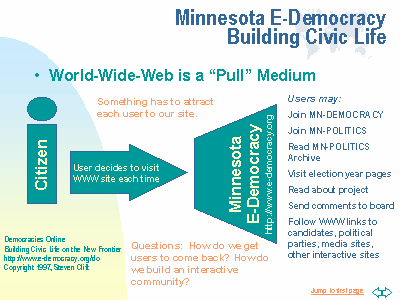
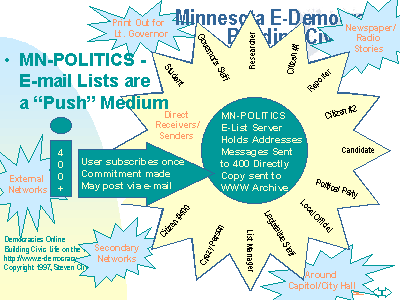
E-mail discussions work because subscribers only have to make a commitment once when they join. With the web, people must proactively decide to visit a forum every time they go online. To help you on internet marketing discussions you can checkout Internet SEO companies for 2018. The job of the forum host or facilitator is to build and maintain a participatory audience by keeping message volume in check and mediating disputes in a fair manner. You can also check out https://www.shakespearemedia.com.au/services/#corporate-videos for more online marketing services.
Step-by-step. You can do it.
1. Your Democracy – Pick your geographic area according to a political jurisdiction. Democracy is based on geography – so your town, county, state/province, or country would work. Consider starting with an area under 6 million in population. This just seems to work better. Neighborhoods are also a natural starting point, but try starting city-wide first and encourage others to establish neighborhood e-mail lists.
2. Charter – Draft a discussion charter, rules, and guidelines. This is essential. Your two paragraph description of the forum will set the tone for the e-mail list. It is much easier to start with good rules than to add them later. We have found great success with two rules – 1. No one may post more than twice a day. 2. All posts must be signed with the participant’s full real name and city.
See the Background Resources in the right column for models to use.
3. Working Group – Create a working group or club to serve as the non-partisan, likely non-profit, trusted, neutral host for the discussion list. The host organization must be issue neutral for a true online public commons to develop. Get your working group to discuss in detail and agree to the draft charter. Develop and assign specific list management roles. If you have an interest, not just in Minnesota, E-Democracy can serve as your legal host and provide technical support. Contact us.
4. E-mail List – Set-up the e-mail list and web archives. If you can find a local site to donate services all the better. If not try one of the recommended free services in the right column or contact E-Democracy to join our efforts. With these free services it only takes a few minutes to technically set-up a list. Don’t let this fool you. The hard work is yet to come. You might consider one list for unmoderated discussion and one for moderated announcements if your area has a large population or lots of subscribers.
Be sure to place a text footer at the bottom of each list message that tells someone how to subscribe/unsubscribe. This Samba Binary Options Website will reduce the number of technical requests and turn every forwarded message into a marketing tool to promote the forum. If you want to learn on how to advertise cleaning business services techniques, visit weblaunchlocal.com for more information.
5. Recruit – Your discussion subscribers must be recruited one at a time. Period. Build it and they will never come unless you tell them it is there. Set a minimum number of subscribers you want (say 100) before opening the discussion for postings. Develop a recruitment list with the help of others and e-mail, call, and physically visit community leaders, elected officials, and local journalists to get them on the list. Average citizens will not waste their time presenting their views if they feel no one who matters is listening. However, don’t put the success of the forum on the shoulders of elected officials – invite everyone to join as citizens. Politicians will talk because, like other participants, they will see the discussion as an agenda setting tool. Also, the more people subscribed when you open the list for posting, the broader and deeper the sense of community ownership. Consider other in-person recruiting events in the community and have a sign-up sheet with plenty of room to clearly write an e-mail address.
6. Publicity – Be sure to open with a coordinated publicity campaign in the early stages. Use your initial pre-opening recruited members to help recruit others and to develop a regional press list. Be sure to get the full e-mail subscribe instructions everywhere. Only sharing the web address for the list information/sign-up will greatly limit the number of people who sign up. You will get one major press hit. You might try special online events, like a candidate E-Debate or other online events/consultations to generate publicity and awareness of the forum. Celebrate list anniversaries by encouraging in-person picnics and happy hours at local venues.
7. Facilitate – Make all subscribers feel welcome. Send private encouragement to those who participate. You will have much better success gearing the forum toward local issue discussions and away from flame wars if you first get on their good side by building a trusting relationship. Send public decorum notes on an occasional basis and seed new topics to keep the discussion interesting or to shift attention away from a negative thread. On rare occasions you will need to publicly ask people to stop or better yet move it to a different forum. Try to address the abstract discussion trend or group as a whole whenever possible. Be firm, be fair, but remember the interests of whole instead of worrying about a few individuals who think it is their right to talk about whatever topic they want. Keep people true to the scope of the forum outlined in the charter.
8. Reminders – Send monthly reminders about the list charter and rules and encourage the subscribers to recruit more participants.
9. Join Others – The best way to connect with others around the world who are building online public commons in their democracy is to join the Democracies Online Newswire. Please share your public announcements and send queries to your peers.
Background Resources
- A Wired Agora Presentation
- MN-POLITICS Charter and Rules
- St. Paul Issues Forum Charter
- Minneapolis Issues Forum Archive (on left)
- Training from E-Democracy
- Research on E-Democracy style forums
Diagrams
Click image for larger size.
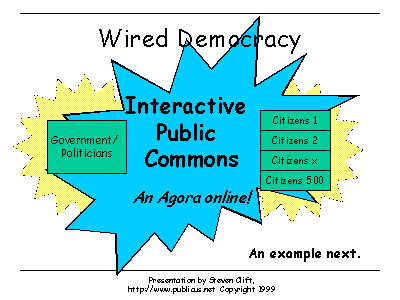
Interactive Public Commons – Agora
Web is Passive – Demo Online
E-mail is Active – Demo Online
Technical Resources – E-mail Lists
Once registered with these services you can start your own free e-mail list with web archives:
- YahooGroups
- Topica
- SmartGroups
- CommunityZero
- GroupCare
What about newsgroups? Political newsgroups do exist in many places around the world. Visit Google Groups to find groups of interest. While the web has democratized access to newsgroups, local groups tend have a limit audience at the local level. Few people with political power or influence use newsgroups. They are the best place to send unruly e-mail list members who can’t swallow your two posts a day rule.
What about web forums? Newspapers tend to host the most active online discussions on local and regional issues. Discussions tend to be in response to specific stories and the online space tends to function as a privatized discussion connected to the news outlet. Useful, but generally not a place for people to organize new efforts politically. Web forums also are used at a more local level for organizing and hosting online special events. Read some hosting advice from David Woolley. Our friends with e-thepeople are doing a good job with policy discussions on the web as of late.
What about chat? Chat is almost entirely useless for many to many political discussions. Useful implementations tend to be moderated live interviews with candidates, elected officials, and guest experts.