
Yearly Archives: 2002

E-Democracy: The Promise of the Future is a Reality Today (Speech in Japan) – By Steven Clift – 2002

E-Democracy: The Promise of the Future is a Reality Today


This speech was given as a 30 minute keynote address. It was received warmly as an “easy to understand speech in English” to over 400 people at Japan’s first conference dedicated specifically to e-democracy.

stevencliftinjapan


E-Democracy: The Promise of the Future is a Reality Today

Speech by Steven Clift
NTT Data INFORUM 2002 e-democracy symposium
http://www.nttdata.co.jp/rd/riss/inforum/2002
Tokyo, Japan, May 22, 2002

This speech is available in Japanese from:
http://www.nttdata.co.jp/rd/riss/inforum/2002/keynote02.html
Good afternoon.

In the spring we envision many possibilities. Today we live in a spring with exciting new potential for better government, for stronger communities, and more participatory citizens. This spring flows from the information and communication technologies (or ICTs) revolution.

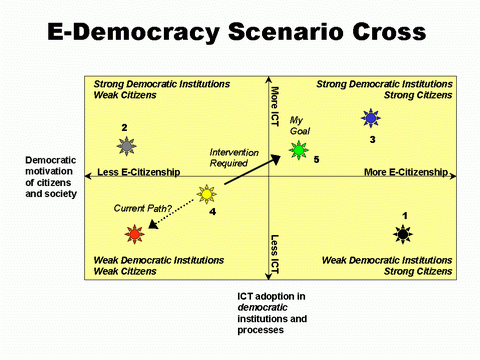
However, unlike with technology, we are not experiencing a revolution in democracy. We are not experiencing a revolution in governance or politics. Rather, we are in the midst of a ICT-fostered political evolution that will change our leaders and citizens alike. We do not know whether this technology-based evolutionary struggle for political relevancy will strengthen or weaken democracy.

We must ask the questions – Will ICTs build on our humanity and democratic ideals? Or will instead technology accelerate the pace of life so much that we will no longer have time to contribute to our broader communities or public lives?

I believe that the future of our information age communities, our democracies, it is up to us. In each of our countries, we must work hard to secure the benefits of ICTs in decision-making, government transparency and government accountability. It is important to support online citizen participation in order to help solve public-problems. The alternative is to accept weakened democracies, and less responsive governments.

Technology is naturally used for private connections within our families and within our circle of friends. We hear a lot about e-commerce and online entertainment and other hyped possibilities. Now it is time to consider “public” uses that go beyond our important private lives.

Even within the public sector all around the world, the use of technology continues to focus overwhelmingly on privately oriented individual and business transaction services without consideration of the potential of “representative e-government.” With “representative” I am referring to those institutions of government like parliaments or local city councils. I am concerned that our elected officials will not have access to the information tools required to govern effectively based on citizen needs and input. We need to develop technologies and methods that ensure that citizens are heard by our representatives in the noisy information age.

There is nothing wrong with using ICTs in our private lives; private communication, since the invention of paper, has been the economic engine of communication systems. There is nothing wrong with using ICTs to provide government services. I support it. People want convenience.

Our challenge today is to build momentum for the use of ICTs in our public lives. It is time to connect online with our neighbors and diverse people in our local communities. We must interact publicly online with civil servants at city hall as well as learn and deliberate on major public policy issues facing our respective nations. Simply put, an information society, requires information age governance and citizens.

There is nothing like spring. Everything seems possible again. Almost reborn.

Speaking of spring, the introduction I wrote for this speech actually was inspired by an opportunity the other week to fill my lungs with spring air after long cold winter. I was soaking up the evening sun on Lake Calhoun in my home city of Minneapolis, Minnesota.

Minnesota is right in the center of North America with Canada just to the north. It is home of companies like 3M. It is home of the Mall of America. In fact the mighty Mississippi River doesn’t start in Mississippi, it starts in Minnesota, in the northern part, as a small stream. It winds its way of 2000km to the Gulf of Mexico, and the process helps to define the center of the of United States.

Minnesota E-Democracy – http://www.e-democracy.org

Let me share my direct experience from Minnesota. Minnesota E-Democracy is today a very small stream, but perhaps its ideas and practices will flow out of our state and help define the future of democracy.

Back in 1994, when I was 24 years old, I sent out a simple e-mail. I sent it to group of people interested in online community networking. I asked – who would be interested in putting candidates for U.S. Senate and Governor in Minnesota on this new thing called World Wide Web? I also asked – who would be interested in organizing a public e-mail list, an online discussion, where people could discuss the elections? The volunteer response was amazing. Early “e-citizens,” as I call them, came from everywhere to help build the world’s first election-oriented web site.

Here are three lessons we have learned over the years:

1. Citizens can make a difference in politics with new technologies.

2. Discussions of state and local issues will continue after the elections are over. In fact, the quality of discussion improves once citizens can focus on issues and not just electoral politics..

3. Agenda-setting is key. Generating public opinion through many-to-many communication is a unique strength that ICTs bring to democracy and community.

Today, eight years later, Minnesota E-Democracy, is a thriving non-profit NGO, volunteer-based organization, which helps people navigate political, government, and election information from across Minnesota. Most importantly, we serve as a host for online information exchange and discussions of state and local issues. Our citizen-to-citizen and citizen with government online discussions prove the democratizing potential of the Internet is not just a myth. They also prove however that democratic intent in the use of ICTs is required to foster better democratic outcomes. No democratic intent – then I doubt we will see many democratic outcomes.

Our largest forum, the Minneapolis Issues Forum opened in 1998. Over 800 people today including our Mayor, neighborhood activists, journalists and others – participate in daily discussions. This forum has a real agenda-setting impact in our community. The local discussion topics, from parks to police, often show up in the media and go around city hall as well as community meetings.

The online forum in St. Paul, across the river from Minneapolis, reflects a different style of more personal politics. Volunteers help the forum manager by sharing links to local news stories in order to prompt discussion. Down the river a two and a half hours drive from Minneapolis and St. Paul, you reach the small city of Winona, and the forum there connects community leaders and citizens for dialogue on local issues as well as organizes in-person events and special events online to talk about issues like education. They had discussions about simple things like where they should put stop signs, is our community a friendly community. This shows that local relevance is key to building an interactive foundation that matters to everyday citizens.

My experience leads me to believe that without e-citizens, there can be no e-democracy.

I know that you will learn more about the Minneapolis Issues Forum during the panel discussion. But in terms of lessons, let me point out that most content on the Internet is one-way, particularly content from government, political groups, and the media. Most online discussions are rarely local or regional, they are often global based on hobbies and unique life situations.

My secret recipe for successful e-democracy is make it two-way and embrace geography, particularly local geography.

On our forums, people are just as much readers as they are content producers. By sending a simple e-mail to the group, anyone can share an idea, ask a question, post an event announcement or express an opinion about a local or state issue.

Minnesota E-Democracy’s volunteer forum managers, work to keep discussions issue-focused and respectful. Our guidelines encourage personal responsibility with advice like, “E-mail unto others as you would have them e-mail unto you.” Civility and respect are essential.

Participants must sign their posts with their real names and may not post more than twice a day. These rules encourage more people to participate in the discussion, they also help ensure that people are accountable to their words they write and share with others.

Let’s be realistic. If you go on the internet today, 99 percent of the political discussion you will find is disconnected junk, our discussions in Minnesota are only half junk. The miracle is that at least half of our discussion has real value. Our organization’s mission is to learn about that and build upon that value. We seek to help other communities across our state and beyond build new online forums where none exist today. I hope to return to Japan a year from now in order to connect with dozens of similar forum organizers across your own country.

Government

“Government by day, citizen by night.” That was my motto. While I volunteered for Minnesota E-Democracy in 1994, I haven’t told you about my previous day job. From 1994-1997, I coordinated e-government for the State of Minnesota and I ran the homepage for our state government. My past government experience and meetings with government leaders from dozens of countries since 1997, gives me an important perspective I like to share.

E-democracy, the concept – not the organization, is alive and gaining momentum within governments around the world. You must look through the rhetoric about the democratizing potential of the Internet for concrete actions. The use of ICTs can deliver on democratic ideals like transparency, accountability, policy consultation, better representation, and citizen participation.

While I’d like to see civil society organizations like Minnesota E-Democracy in every city, state or prefecture, and country, government-based e-democracy buy ambien online fast shipping efforts are currently the most sustainable. Government action and e-democracy investment is vital today.

In a democracy, government is something we all own, something we have a right to influence and change. We want government services anywhere at anytime, we must also ensure effective forms of online and in-person democratic participation on our own time from home, work, school, or on the go.

Speaking of “on the go” – In Japan, where mobile communication is so strong, I hope to learn about your ideas for government-led e-democracy and perhaps mobile or “m-democracy”?

When you first heard the term “e-democracy,” did you think “online voting?” Someday you will be able to vote online. I support it if it is combined with at-home postal voting and the required security.
However, I am skeptical that online voting itself will make government more effective or democratically responsive.

Voting is an act where citizens give their power to others in order to be represented. I fundamentally believe that citizens must be able to participate in governance all the time, not by directly voting on everything, but in meaningful ways that involve their ideas, energy, and abilities. Therefore I encourage governments, as stewards of the public trust, to invest most of their e-democracy resources between elections. This will allow us to reap the benefits of the information society through improved public decision-making and better social outcomes from government work and citizen involvement.

E-democracy as we will experience it exists in bits and pieces scattered across the Internet today. You can read all about it on my website http://www.publicus.net and on my Democracies Online Newswire. But let me share with you today some leading examples.

Example 1 – Policy and leadership

A recent UK report on e-government found that the average UK local government provides only one-fourth of the potential online services that the leading local governments in UK are currently able to provide. In Sweden, studies have found that having an in-house “champion” or leader. It is a better indicator of e-government success than how large the city is or how much money they have. Applying the lessons from those studies, it is common sense to conclude that most of the leading government-sponsored e-democracy applications can easily be imagined and likely exist somewhere today. More universal, “more universal” is the keyword, e-democracy in government will thrive at the national and local levels around the world where the “champions” are and political leadership come together to make things happen.

Speaking of political leadership, in the UK, the E-Envoy is preparing a major E-Democracy Policy and the parliament now led by MP Robin Cook has a committee exploring the issue of E-Democracy specifically. In the State of Queensland, Australia, where I was last November, they released their e-democracy policy and are busy building their e-democracy applications. While policy leadership is not required to have exciting government e-democracy developments, it will help secure the resources required to build the next generation of applications.

Example 2 – E-mail Notice and Personalization

While your Prime Minister Koizumi’s e-mail newsletter may seem like old news in Japan, there is nothing like it on the same scale anywhere else in the world. I know of no other world leader who can directly e-mail millions of people. From the local level on up, every elected official should have the ability to send e-mail newsletters to interested constituents.
Moving beyond elected officials for a moment, right now in the City of St. Paul, Minnesota you can subscribe to key documents like public meeting notices and agendas. The moment the staff upload a frequently updated document you can choose to be notified. This is called personalization.

I ‘d like you to imagine a “My Democracy” service where citizens could type in their address, select topics, and be given options for web, e-mail, instant message delivery or wireless notification of important information they care about. This innovation does not change what information a government makes public. It simply unleashes the political power of timely access and use. Unfortunately there are only a few government sites that employ these techniques today. Luckily there are thousands of the commercial and academic sites from which we can learn

Example 3 – Wired Elected Officials

I travel the world looking for Wired Elected Officials or “Weos” as I call them. I’d like to find out who Weos of Japan are.

If you take a look at Jan Hamming, a local councilor in the Tilburg, The Netherlands, his web site is the closest thing to an online constituent office you would gain access to the information experience available in his physical office. While nothing replaces the value of direct in-person contact, Jan has found that his online chats and other forms of online constituent input brought him closer to students, low-income citizens, and immigrants. Why? For many people interacting with a politician online is much less intimidating than going to a government office.

Shouldn’t all elected officials have the tools to better represent their constituents? Yes, it is time to invest in real online services for elected officials of all political parties so that our voices may be better heard through them in government decision-making.

Example 4 – Online Consultation

E-Rulemaking by U.S. Federal government and online consultations now being hosted by governments in Canada, Australia, and European countries are working to better connect citizens and diverse interest groups to the administrative policy side of government. For those interested in this, I have a “Top Ten Tips” article about online consultation on my web site.

One clever mobile democracy story, perhaps online consultation in its simplest form, comes from Finland. The transit authority in Helsinki has employed a creative two-way strategy – if you have a suggestion for the bus or tram service you can send it in via text messaging on your mobile phone. It will automatically appear on their public web site for all to see. If the bus drives past you without stopping, perhaps soaks you with water from a mud puddle, you can hold the agency publicly accountable. Interestingly enough, the number of compliments, yes compliments, to their text message system, has positively surprised the transit authority.

Example 5 – Representative E-Democracy

Most e-government resources reside in the administrative side of government. It makes sense that in most countries, this side of government can afford to invest in next generation e-democracy and e-government activities. While I support this activity, I am concerned about the long-term implications of connected executives and disconnected representatives.

I believe that the online activities of representative institutions must also be accelerated. We must not allow ICTs to be used in ways that cause unintended shifts of power away from our representatives. We need to ensure that public bodies can hold each other accountable and not overturn our constitutional designs based on inequitable investments in information and communications strategies and applications. I expect parliaments, legislatures, and local councils to take up the ICT challenge in order to remain politically relevant and keep what power they have.

Today, in Minnesota, the legislature is leading the way. They are beating the online efforts of the executive, the executive led by Governor Jesse Ventura, former pro-wrestler, you may have heard of him. The legislature streams the debate live on the Internet from the floor of the chamber and also put it on television. When an amendment to legislation is proposed you can get a copy online from home at the exact same time the legislators get it themselves.

Legislators carry laptops and plug them into the Internet while in the legislative chamber. You can send them e-mail while they are on television and share information they might find useful in the debate. Legislators are also information seekers, they use the web from the chamber to research and hope to find quotations and statistics they can use moment or later in the legislative debate.

Another big step for local councils and parliaments will be the sharing of decision-making input from their public processes with others. This involves taking place testimony, in-person meeting and put them online for broad access. We need to take this one step further and encourage people to exchange information on a two-way basis as part of official online public hearings.

Before I conclude I want to share a “bookmark” about the other democratic sectors. Online activism, online campaigning and political parties as well as the role of the private sector and the media also define the future of e-democracy. My “E-Democracy E-Book” on my web site http://www.publicus.net/ebook explores these areas in much more detail. All the sectors of democracy need to come together to do their part.

Conclusion

It is spring, or I guess early summer now in Tokyo, but still spring in Minnesota. We must dedicate ourselves to meet the public challenges the new season and take advantage of the opportunity before us.

As we move forward, most democratic actors in society will collaborate and compete in a healthy way in order to build a bright future for democracy. Our information societies will make democracy more real and compelling to the average citizen. They will transform governance and citizen participation. They will help us improve our communities and nations within which we live.

The only way to make this vision a reality is to roll up our sleeves and get to work. Together, we will not allow the use of technology to degrade our democratic ideals and needs. Instead, we will ensure that ICTs deliver on what is good in our societies. We will use it to bring communities together and strengthen our nations and world in ways we desire and can imagine.
Thank you.
Votare on line sarà presto una scelta politica – MediaMente.It Interview with Steven Clift in Italian – 2002

Source version

Clift: costruiamo la democrazia elettronica byte dopo byte

“Votare on line sarà presto una scelta politica”di Marta Mando’

Per l’esperto americano Steven Clift, che da anni si occupa dell’uso di Internet per la politica e l’amministrazione, la democrazia elettronica deve essere costruita dal basso col contributo di tutti i cittadini.

Elezioni presidenziali negli Stati Uniti in “stand by”: secondo lei ciò che sta accadendo è espressione di una democrazia solida o semplicemente c’è qualcosa che non va nel vostro sistema elettorale? Se fosse stato possibile votare via Internet sarebbe accaduto lo stesso?

A distanza di secoli, o anche a intervalli più brevi, ogni democrazia si imbatte in situazioni che la sfidano. Queste elezioni, incredibilmente incerte, hanno evidenziato l’importanza della legittimità del processo di voto. L’uso di moderne tecnologie di voto è essenziale. I sistemi basati sulle schede perforate, nei luoghi in cui sono tuttora in uso, dovrebbero essere eliminati. Nel mio Stato, il Minnesota, la maggior parte delle contee usa sistemi computerizzati per la lettura ottica delle schede. Il presidente di seggio sa immediatamente se qualcuno ha votato erroneamente, la sua scheda viene distrutta e gliene viene consegnata un’altra.

Queste elezioni americane saranno probabilmente le ultime con i tradizionali seggi elettorali. Per le prossime elezioni, nel 2004, si farà forse un ricorso massiccio al voto elettronico. Potrebbe indicare quali sono i rischi e quali i vantaggi del voto online?

Al contrario, queste elezioni ritarderanno di anni il voto via Internet. Elezioni con distacchi così ridotti ricordano che la legittimazione democratica si fonda su un voto limpido, verificabile e affidabile. Votare via Internet? Senza carta? Alcuni dei sistemi elettronici usati nei seggi elettorali emettono delle ricevute stampate. Finché la perdita di voti elettronici non sarà evitabile nel 99,99 per cento dei casi, deve rimanere una registrazione scritta.

Il trasferimento dati non è ancora a prova di manipolazioni. Come si potrebbe, quindi, votare online? Pensa che il voto elettronico possa estendere la partecipazione dei cittadini, limitando l’astensionismo, gli errori e le frodi?

Col tempo la scelta di votare online sarà sentita come una scelta politica e non tecnica. Avremo sistemi per votare online in grado di soddisfare i rigorosi requisiti delle operazioni di voto. Nonostante queste garanzie molti si opporranno al voto online per ragioni politiche. Il sistema bipartitico americano, involontariamente, non incoraggia i nuovi votanti a partecipare. Nel nostro sistema, infatti, chi vince prende tutto e gli elettori occasionali causano tale incertezza ai partiti politici che i loro voti spesso non sono ricercati dai candidati. Inoltre, senza l’alternativa del voto per posta, sono nettamente contrario al voto online a causa della natura esclusiva https://nygoodhealth.com dell’accesso alle tecnologie.

In che modo l’uso di Internet può cambiare la partecipazione democratica e la politica?

Internet sta già cambiando la democrazia. Se si tratta di un cambiamento in meglio o in peggio è da vedere. Abbiamo bisogno di una generazione di “e-cittadini” che usino Internet per agevolare la partecipazione e il processo di preparazione delle decisioni. Non dovremmo accontentarci di una versione online dell’attuale politica dall’alto. Internet può essere usata per scopi democratici, per promuovere cambiamenti positivi. Si può cominciare dal basso con annunci via e-mail e liste di discussione (un’agora on line) nei quartieri o in comunità più ampie. Dobbiamo costruire la “democrazia elettronica” byte dopo byte. Non ci sono scorciatoie. Accadrà solo se tutti noi daremo un contributo e faremo la nostra parte.

Può dare una breve definizione di “democrazia elettronica”?

Democrazia elettronica ha tanti significati quanti ne ha il termine democrazia. Un decennio di esperienza nella costruzione di una democrazia elettronica mostra che la maggior parte di noi vuole migliorare il mondo che ci circonda. Vogliamo processi decisionali aperti ed efficaci, che prevedano l’impiego di Internet. Alcuni sperano in una democrazia più diretta, altri vogliono migliorare la democrazia rappresentativa. Io sono un “incrementalista radicale” che sostiene la tradizionale democrazia rappresentativa ma si sforza di accrescere il potere dei cittadini nella risoluzione dei problemi pubblici. Perché aspettare che il governo sia al nostro servizio quando possiamo usare gli strumenti telematici e la società civile può assumere la guida della risoluzione dei problemi dove e quando si presentano?

Potrebbe accadere che chi non conosce Internet rimanga escluso dalla partecipazione politica?

Certamente. Tuttavia la democrazia subirà un duplice colpo se useremo questa scusa per non sviluppare strumenti idonei a un impegno democratico online. Man mano che più gente usa Internet diventa sempre più difficile dar forma alle aspettative degli utenti, vecchi e nuovi. Dobbiamo far sì che la rete possa essere un luogo per compiere scelte di carattere pubblico tanto quanto per conversare con gli amici, scaricare file musicali e fare acquisti.

Cosa ne pensa della pubblicità elettorale in rete? È un sistema che funziona negli Stati Uniti?

I candidati e i partiti politici non hanno fatto un buon uso di Internet per la pubblicità elettorale. Fino a poco tempo fa il motivo principale dell’impiego di Internet in campagna elettorale è stato quello di attirare l’attenzione dei media. Alla fine, nel 2000, hanno cominciato a realizzare mailing list per motivare e attivare i sostenitori durante la campagna. Il partito Repubblicano si è sforzato di combinare i banner pubblicitari con la costruzione di una rete di sostenitori collegati per posta elettronica.

E-Governance to E-Democracy: Progess in Australia and New Zealand toward Information-Age Democracy – By Steven Clift – 2002

E-Governance to E-Democracy:
Progess in Australia and New Zealand toward Information-Age Democracy

By
Steven Clift


Online Strategist and Public
Speaker 


http://www.publicus.net

Editor, Democracies Online
Newswire


http://www.e-democracy.org/do

Copyright 2002 Steven Clift
– All rights reserved. This article may be freely linked to, cited or quoted
with simple
e-mail notification
to the author and a commitment to share copies of any final derivative
works. The full text of this article may only be redistributed online or
in print with the express permission of the author and the Commonwealth
Centre for Electronic Governance.


This article was commissioned
by the Commonwealth Centre for Electronic Governance.  See Part
B of their International Tracking Report Number 3
.


E-Governance to E-Democracy:
Progress in Australia and New Zealand toward Information-Age Democracy 

Prepared for the Commonwealth
Centre for Electronic Governance by Steven Clift <http://www.publicus.net>
in March 2002.


Introduction 

E-democracy means different
things to different people.  In different countries and political
systems the term is generally connected to the broad use of the Internet
in politics, advocacy, elections, and governance. In most places it is
misunderstood to primarily mean e-voting. This article focuses on the dynamic
aspects of e-democracy between elections in governance. 

My working concept of e-governance
relates to the preparation of government as it reacts to information, technology
and communications (ICTs) trends on its traditional governance and role
in society.  It is the climate for governance in an online world. 
E-democracy builds on e-governance and focuses on the actions and innovations
enabled by ICTs combined with higher levels of democratic motivation and
intent. 

This paper focuses specifically
on one element of e-democracy – governance and representative democracy
in the information age.  On my recent visit in November 2001 to Australia
and New Zealand (in-person and online) I discovered a number of activities
deserving greater attention. 

E-democracy within government
remains at an early stage around the world, but these two countries should
be listed in the top ten in terms of government interest.  The role
of government in e-democracy is important.  Investments in online
applications and new approaches in the official representative and consultative
processes are considerably more sustainable than projects from the “outside”
that typified early e-democracy explorations in the United States. 

This article focuses on four
key areas: 

1. Policy development and
political leadership 


2. Enhanced information
access and e-mail notification 


3. Representative strategies
in parliaments and local councils 


4. Online consultation and
communities of practice 

With each area I will provide
examples and web addresses for further information. 


1. Policy development
and political leadership 

The current e-democracy policy
activities of the UK government <http://www.edemocracy.gov.uk
within the E-Envoy’s office <http://www.e-envoy.gov.uk>
and the new E-democracy committee of the parliament are being watched closely
in Australia and New Zealand.  The recently released OECD guide titled,
“Citizens as Partners Guide: Information, Consultation and Public Participation
in Policy-Making” <http://www1.oecd.org/publications/e-book/4201131e.pdf>
has also generated new interest and comment within government circles in
these two countries. 

In the e-government world,
the need for political leadership and vision is stated again and again.
Rarely do heads of government or members of parliament hear from citizens
about the need to better utilize ICTs in government.  It simply does
not rank up there with the services people receive directly like education
and health care. 

Combine this reality with
information and technology agency “silos” that often resist cooperative
approaches designed to serve citizens from the citizen perspective and
you have a very complex situation where inaction is the least risky route. 
In countries where political leaders have made numeric goals related to
e-government, such as Australia and New Zealand, my personal observation
is that with those goals, the political cover provided allows champions
within government to deliver and gain access to the resources required
to meet those goals. 

According to the UK e-government
benchmarking study about Australia, “The 1997 announcement by Prime Minister
John Howard that all appropriate Federal Government services would be provided
online by 2001 has provided significant impetus to progress.” <http://www.e-envoy.gov.uk/publications/reports/


benchmarkingV2/summary_aus.htm>. 
In New Zealand the government lists in their E-Vision <http://www.govt.nz/evision/>
a number of e-government five-year goals to help “people judge what progress
has been made.” 

Why is this important to
e-democracy?  It is my sense that the governments with integrated,
high profile e-government service efforts are the first to expand actively
into to the area of “representative e-government.”  By representative
e-government, I mean government bodies that either represent people like
parliaments and local council or those departments and agencies that consult
with citizens and stakeholders often as required by law. 

While I argue that governments
have an obligation to develop e-services and e-democracy at the same time,
most governments are focused on services first. In many places the policy
seems to be services first, democracy later. While parliaments and other
representative institutions are online, their information technology and
communication resources have paled in comparison to the administrative
side of government. Democracy is falling behind and power is shifting as
a result of a non-policy that by default gears most resources toward the
“holy grail” of transaction services. 

This is beginning to change.
Some parliaments and representative bodies are increasing their information
and communication technology investments and leading government departments
are beginning to adapt their in-person citizen and stakeholder consultation
requirements to the information age. 

At the national level in
Australia, the National Office of the Information Economy <http://www.noie.gov.au>,
which coordinates e-government, is taking up the issue of online citizen
engagement <http://www.noie.gov.au/publications/speeches/rimmer/


canada1710/sld016.htm>. 
They are at an early stage and their staff has indicated that they want
to explore this issue in terms of administrative responsibilities. 
As host of the joint Online Council of Federal, State and Territorial leaders
they discussed e-democracy at their March 2002 meeting <http://www.noie.gov.au/publications/media%5Freleases/


2002/mar2002/online%5Fcouncil.htm>. 
The Council “acknowledged that e-democracy is a significant issue emerging
for governments in Australia and agreed that Australia’s position as a
world leader in eGovernment continues to be reflected in progress regarding
e-democracy. Ministers were pleased with the progress made to date, in
terms of the application of online consultation, and in the development
of policies and strategies to allow people to better engage with government.” 


The State of Victoria announced
an E-Democracy Inquiry <http://www.dpc.vic.gov.au/domino/web_notes/newmedia.nsf/


ebfd7a9e83f839b34a2568110023b2e3/

8747b9a1469ada824a256b66007c3252?OpenDocument

in February 2002. 
Through both Liberal and Labour governments, Victoria has a long history
of funding ICT development across multiple sectors of their state. 
The state library’s VICNET <http://www.vicnet.net.au>
project helps connect people and organizations to the Internet through
training and education and unlike most access promotion projects it provides
civic navigation of regional content.  Multimedia Victoria promotes
better understanding of things “e” including e-democracy <http://www.egov.vic.gov.au/Research/ElectronicDemocracy/voting.htm>
and continues to push aggressive e-government development.  Back in
1999, the Victorian government initiated a previous democracy online exploration
that led in part to a small online consultation experiment in late 2001. 

Last, and most important,
are the e-democracy policy developments in the State of Queensland 
<http://www.premiers.qld.gov.au/about/community/democracy.htm>.
In November 2001, the Queensland Cabinet approved both a comprehensive
community engagement policy and a special e-democracy policy framework.
This is the clearest sign of political support for e-democracy issued by
government in the region, perhaps anywhere in the world to date. 

In the forward of the Community
Engagement Division’s Direction Statement, Premier Bettie states, “The
role of Government is changing. The community is seeking better Government
leadership through increased public participation in decision-making. 
I am willing to accept this challenge.” He goes on to say that, “Strengthening
relations with citizens is a sound investment in better policy-making by
allowing government to tap new sources of relevant ideas, information and
resources when making decisions.” 

Within this document, a commitment
is made to a Queensland E-Democracy Three Year Trial. Approved by Cabinet
and assigned to the Community Engagement Division, this is the highest
level of formal e-democracy policy interest that I have seen in any government.
Current developments in the UK will certainly place it in the lead on a
national scale, but Queensland may be the place to watch in terms of measurable
and identifiable outcomes due to its relatively modest population of around
3 million people. 

Here are some important excerpts
from Queensland’s “E-democracy policy framework” (see <http://www.premiers.qld.gov.au/about/community/pdf/edemocracy.pdf>
for the full version of this extremely important document): 


The Queensland Government
is committed to exploring the many new opportunities the Internet brings
and to discovering ways in which this medium can strengthen participative
democracy within Queensland -The Smart State. 

E-democracy is at the convergence
of traditional democratic processes and Internet technology.  It refers
to how the Internet can be used to enhance our democratic processes and
provide increased opportunities for individuals and communities to interact
with government. 

E-democracy comprises a range
of Internet based activities that aim to strengthen democratic processes
and institutions, including government agencies.  Some of the ways
in which this can be delivered include: 

· providing accessible
information resources online;  · conducting policy consultation
online; and  · facilitating electronic input to policy development. 

It is the responsibility
of government to expand the channels of communication to reach as many
citizens as possible.  The Internet is not inherently democratic,
but it can be used for democratic purposes. The full implications of how
the Internet will enhance this interaction are yet to be explored. 


Their three-year trial includes: 

The Queensland Government’s
commitment for the next three years is to: 

· post a number of
issues on the website on which the Government desires wide consultation
and feedback; 

· provide online access
to Government consultation documents relevant to those issues, such as
discussion and policy papers and draft bills; 

· broadcast Parliamentary
debates over the Internet; and 

· develop a system
to accept petitions to the Queensland Parliament online. 

In my brief time with
New Zealand <http://www.e-government.govt.nz/participation/>
e-government officials, they too presented an early policy interest in
e-democracy. In most governments, now is the time to get policy questions
on the table.  One indication of forward thinking in New Zealand,
which I’ll mention later, is their extremely high profile presentation
of information on government consultations on their home page. 

From a global comparative
vantage point, it is my sense that you don’t need an e-democracy policy
to have a government with a number of useful democracy services online.
However, when it comes to second and third generation applications and
government-wide initiatives that require resources and political support,
high level policy direction will accelerate and deepen activities. It is
important for government leaders to be able to see e-democracy progress
and celebrate the innovations taking place under their noses.  Governments
with a “just do it” e-democracy history will benefit from policy direction
along with those who require an e-democracy policy to develop applications
and initiatives. 

In conclusion, a strong e-democracy
policy with specific measurable goals is essential to promote long-term
progress.  The alternative is to muddle around with limited accountability
like we see with e-government as a whole in places without aggressive evaluation
and goal setting.  Citizens can’t choose governments that do a better
job with e-democracy like they can choose between competing commercial
web sites.  This is why top level political support, articulated in
policy is so essential to move government organizations and their democratic
processes forward into the information age. 


2. Enhanced information
access and e-mail notification 

An argument was made in the
late 1990s that the natural evolution of e-government was from information
access to the provision of transaction services. Providing better and more
effective access to information was not hip in a world dominated by headlines
about the future of e-commerce. 

However, to this day the
vast majority of Internet users (U.S. users surveyed by the Markle Foundation
<http://www.markle.org> as part
of their Internet Accountability study) view the web as a “library” and
not an online shopping mall. The reality is that one of the primary functions
of government is the creation and dissemination of information. And the
lack of comparative focus on improving the methods of online access to
ever increasing amounts of government information online has lead to a
crisis of online navigation and usability for citizens. 

Try to imagine a library
without a card catalog where undated books are piled in boxes located in
different rooms.  Oh, did I mention that some books vanish and change
without notice and that the rooms are organized by agency without doors
or hallways to connect them. In this library, you have to climb up a rope
to the roof and repel down into the next information “silo” hoping to find
what you need. Finally, after a few hours of looking a little sign on the
wall tells you that you are in the wrong library completely and need to
go to the library of a different level of government. As I have said before,
if you have a web page and no one can find it, do you really have a web
page? 

Providing timely, enhanced
information access should be a core e-democracy goal of government. 
While much of the information government provides is service related or
not directly related to policy development or decision-making, public accountability
and understanding of public service is greatly improved when people can
easily navigate information and services across government based on their
needs and interests. 

Enter the public portal.
It is my belief, based on conversations in Australia and New Zealand that
they are taking a more balanced approach to e-government than with the
“services first, democracy later” approach I see in my home country, the
United States.  Public portals, with cross agency links and directories
based on topic/theme/audience emerged in places like Canada, Australia,
and New Zealand a year or two earlier than in most other states and countries.
This experience is beginning to build a new kind of civil servant who serves
the citizen online from the citizen’s perspective rather than just being
accountable to a single agency in terms of expressing the agencies view
of itself to the world. These special collaborative online directory efforts
that serve groups or topics (i.e. seniors, youth, or health, new child,
etc.) are building cumulative knowledge and collaborative multi-agency
working clusters. 

Presenting content (particularly
through links) from the citizen (business, organization, stakeholder, etc.)
perspective rather than that of one agency is building a unified brand
identity for the public portal.  It is building audience for government
content and creating citizen expectations for further navigation and content
access improvements in the future.  It is also building knowledge
within government about the kinds of information people actually use versus
those things consultants or citizens might say they want. Within governments
and among governments there is a tremendous opportunity for knowledge sharing
about what kinds of government information is available as well the style,
format and delivery of that information which is most popular. 

Three public portal efforts
I want to mention are: 

Australia – This site <http://www.fed.gov.au>
is latest version of their federal portal. As part of a marketing buy lorazepam overnight effort
for e-government with the state’s they have also launched <http://www.gov.au>.
From the Federal portal they clearly present organized links into the “Government
& Parliament.”  This section not only links to the home page of
parliament, it also helps the user find key sections and related web sites.
Next up is the just released portal that combines national and state resources
<http://australia.gov.au>. As
a side comment, all government portals would benefit from a profile link
<http://australia.gov.au/portals/about_gov.asp>
to a simple and easy to understand explanation of “how your government
works” as well as a tip sheet on how to provide online policy input into
government along with advice on sending in customer service complaints.
Policy input needs to be channeled appropriately and not get stuck in customer
service. 

State of Victoria – This
site <http://www.vic.gov.au> has
some of the most developed theme spaces for links across government. 
As I noted above, Victoria has provided government funding for a number
of online initiative outside the core area of government services. 
Visitors to the Victorian government’s portal quickly get the sense that
this is your “state” and not this is just your “government.”  Their
“Citizens and Community” section on the portal give this sense while the
“Government” section takes you to the representative institutions of their
government. 

New Zealand – This site <http://www.govt.nz>
is unique among almost all government portals.  It is designed much
more as an online news sites (i.e. what’s new across government) with a
pull down menu to frequently request information and services based on
topic. This presentation of “what’s new” across government leads me to
my next set of comments. 


E-mail notification and personalization
of public portal features will lead the next revolution in e-government. 
If today’s government portals represent the aggregate knowledge about user
interest as understood by government, personalization will turn things
upside down and allow citizens, based on their unique interests, to be
notified on a timely basis about information in which they are interested.
The convenience of being told when frequently updated information (or rarely
updated information) is available in a manner chosen by the user is tremendously
powerful.  Imagine a preferences page where you can choose how you’d
like to be notified about a major policy document – e-mail, SMS/Text messaging,
instant messaging, personalized web page.  Services like Spyonit 
<http://www.spyonit.com> allow
you to monitor any web page today for changes.  These features will
be built into the better government portal sites. 

E-mail notification may be
the number one e-democracy application for government in the next five
years. Why? Notification does not require a government to change how and
when it releases a document online, it simply allows people to opt-in to
be told when a document, meeting announcement, etc. is available. 
Timely access to information has tremendous political value. The highly
obscure release of important documents buried deep on an agency web site
will become a thing of the past in e-democracy friendly governments. Making
content effectively available online when the time to comment and influence
policy still exists will be one of the most cost-effective e-democracy
moves by government. 

However, if this is to be
done from the government-wide portal level, which it should when possible
in order to have the greatest whole-of-government impact, a sophisticated
collaborative development scheme will be required. Notification as a default,
not the exception, will require both the automatic and manual aggregation
of document availability and description information and the automatic
dissemination of this information based on user preferences.  This
will require the use of database-driven approaches and likely XML. 
This will go way beyond hand-edited “what’s new” web pages and e-mail newsletters. 
E-mail newsletters are an important starting point and should be established
immediately to build experience with notification. 

While I am sure there are
other examples, the best starting point example of topical e-mail announcement
lists I could find comes from the Australian Human Right and Equal Opportunity
Commission <http://www.hreoc.gov.au/mailing_lists/>
on topics such as Children & Youth, Complaints and Legal, Disability
Rights, Indigenous, Racial Discrimination, and more. This is an important
first step where people can sign-up to receive edited announcements and
updates.  In my opinion every government web site and portal should
have at least one opt-in e-mail newsletter that at a minimum shares what
is new on the site each week or no less than once a month.  An initial
aggregate personalization feature at the portal level is the ability from
one web page to selected or sign-off the e-newsletters of choice from across
government. 

For outstanding early examples
of the more systematic approach we need to look to the UK and some local
governments in the State of Minnesota. The <http://www.info4local.gov.uk
site in the UK is geared toward those in local government seeking updates
about information from central government.  It allows users to receive
instant e-mails on selected subjects and document types from selected UK
government departments.  You can also sign-up to receive links to
new releases, but at this point the coding required to personalize what
you receive is not implemented.  In St. Paul, Minnesota <http://www.ci.stpaul.mn.us>
the use of a service from Govdocs.com <http://www.govdocs.com>
allows people to sign-up to receive key city documents as they are placed
on the web such as city council meeting notices, agendas, minutes and the
like.  City staffers now know how many people will instantly receive
an update about the content they upload. They no longer have to ponder
whether anyone reads what they put online six clicks from the home page. 
This has increased timely awareness of government information in St. Paul
and has firmly established the business case for the work required to fully
integrate online access into city processes. 


3. Representative strategies
in parliaments and local councils 

When I mention the concept
of “representative e-government” a light goes off in people’s head. 
That is right, we already have representative institutions and what they
do online to provide better access to their current processes is important. 
In the early days of e-democracy interest, many assumed it meant direct
democracy where people would vote on everything because the technology
would enable it.  People are now realizing that how often you vote
and how you vote (polling places, by mail, online, or combination) are
primarily political choices. What e-democracy does best is allow representative
institutions to add more participatory features that engage citizens between
elections. 

On my recent trip I spent
a number of days with staff from the Christchurch City Council and met
with a number of those who worked on the Australian Parliaments web presence.
In my recently released “Future of E-Democracy” <http://www.publicus.net/articles/future.html>
speech/article I explore issues related to putting in-person public hearings
online, full featured online constituent offices, and what I called “wired
elected officials” or Weos. I won’t go into detail here. Instead I’ll focus
on some important trends I observed down under and over top (Canada). 

Like many parliaments around
the world, their web sites do not lack substance.  While I have no
knowledge about the specifics of Australia, the general trend is that first
and second-generation parliament web sites are driven by staff champions. 
It is not that Members of Parliament are not supportive; they don’t really
know what they might be missing, so why be too concerned? Also, with parliamentary
forms of government, the Cabinet members get to take advantage of their
department’s online resources while backbenchers and opposition members
have limited online support. 

The “online constituent office”
seems to be emerging as a set of uniform service options or it is unfolding
as political communication tool developed competitively by party caucuses.
I suggest a hybrid approach where as much as possible is developed uniformly
for all members to assist them with their official duties online and only
those highly partisan or election-related online activities be reserved
exclusively for party parliamentary caucus technology. 

In New Zealand, there is
increasing interest in e-democracy at the local level.  For sometime,
the Wellington City Council <http://www.wcc.govt.nz/yoursay/>
has listed current consultations online and has a fairly wired base of
local councilors. 

In Christchurch, the Council
<http://www.ccc.govt.nz/> has
recently assumed day-to-day responsibility for their government’s web presence
from the library.  Christchurch’s deep collection of local content,
presents a fuller community picture than I have seen just about anywhere
else.  Because the local media sites are part of a national online
media conglomerate, the government site is viewed as the highest traffic
site in the community. 

The library will now lead
an exciting project to build an even broader and inclusive Christchurch
Online site with council funding and support.  I am interested in
how this new entity might be able to host discussion and civic interactivity
that the Council itself may hesitate to host on its server. They may have
the foundation for the e-democracy one-two punch that Minnesota E-Democracy
has played in relation to government and media sites in the U.S. (I am
Board Chair of E-Democracy.). 

Along with the Council’s
interest in exploring online consultations, I had a number of conversations
about the tools local councilors need to be better representatives in the
information age. It must be noted that elected officials at all levels
have the most varied degree of technical skill and aptitude of any active
group of players in the e-democracy world.  As official representatives,
they are the most legitimate actors, so how they are supported is fundamentally
important for the future of democracy as a whole.  We do not want
the information age to pass them by.  They must be supported so they
can become more effective information age representatives.  I should
note that that the Mayor of Christchurch stands out for his web site <http://www.christchurchmayor.org.nz/>
and the personality it exudes. 


4. Online consultations
and communities of practice 

Experimentation with government-led
online consultation and hosting of citizen discussions has a strong start
in Australia.  Much of this activity is at the state level. The most
established and cited example on my trip was the government-hosted Talking
Point web forums <http://www.talkingpoint.sa.gov.au>
hosted by the State of South Australia. At this, time these open forums
on public topics are closed while their state elections are underway. 
In addition to these discussions, their Premier has appeared in a number
of live chats featured on the site. 

In Victoria, Queensland,
and the Federal level it was suggested that they are more closely exploring
online special events on specific topics with a start and an end date. 
My advice for “online consultation” hosts is featured in my detailed how-to
article on the subject <http://www.publicus.net/articles/consult.html>. 

Both the New Zealand national
portal <http://www.govt.nz/news/index.php3?type=cco>
and a section of the Australian Capitol Territory <http://www.act.gov.au/government/reports/index.html>
list current consultations taking place in the off-line world.  New
Zealand is unique in that it lists consultations prominently on their home
page and the section with further detail includes links to consultations
hosted by local governments as well. 

In Victoria, an experiment
called “Have Your Say” <http://www.haveyoursay.vic.gov.au/discussion/>
is likely to be incorporated as a feature of the main e-government portal
sometime in 2002.  (Link is down, see bottom of thie DO-WIRE post
<http://www.mail-archive.com/do-wire@tc.umn.edu/msg00347.html>.
An evaluation of their event from October 2001 is pending.  Like many
online experiments, the lack of broad publicity left them with a small
audience. My key piece of advice is that an audience must be recruited
for at least a few weeks before an event starts. 

In Queensland, as mentioned
above, their e-democracy program includes development of a platform for
online consultation across government. This presents an issue that governments
need to explore -should they build a shared platform for consultation used
by multiple departments, parliamentary committees, even the head of government? 
The alternative is a patchwork of online consultation systems implemented
by leading agencies with few systems on smaller government web sites. While
no one platform will serve the needs of all agencies, I’d like to suggest
that building a shared system for online consultation will lead to broader
activity across government. More importantly it will allow citizens to
transfer their knowledge about and experience with the online tool from
one event to another regardless of the host. 

One of the more exciting
government-sponsored interactive examples I have discovered anywhere is
the communitybuilders.nsw <http://www.communitybuilders.nsw.gov.au/>
online “community of practice” hosted by the State of New South Wales. 
If online consultation related to policy development, government-hosted
communities of practice relate to the implementation of policy.  The
Premier of NSW states that the Community Builder initiative is designed
to “to help local communities across the State share ideas on how to enhance
and strengthen their community” … “This site aims to communicate how different
communities have addressed various issues such as enhancing public safety,
stimulating employment and promoting reconciliation. It shows how my government
is forging partnerships with communities around the state. It is very much
your site. Although the Premier’s Department will be responsible for updating
the site and keeping information fresh, the site’s success will depend
on people such as yourself sharing the information you think is relevant.” 
With over 1100 participants, their hybrid web forum – e-mail notification
system with a supporting web site positions government as a facilitator
of public work rather than just as a provider of services. Providing a
many-to-many online space related to a public mandate will allow government
departments to adapt their implementation strategies and incrementally
improve their policy approaches as well.  The Internet improves through
trial and error.  Communities of practice hosted by government may
be a starting point for incremental government reform rather than the huge
mega-project model that often falls on its face.  Finally, through
the VICNET project, the Victorian state government is supporting the creation
of online communities as organized by NGOs, citizens, and others. 
As their MC2 <http://mc2.vicnet.net>
software is upgraded, hopefully with two-way e-mail participation (right
now you must post via the web) it may be extremely useful for governments
and civic organizations around the world. 


Conclusion 

I am extremely bullish on
the future of e-democracy in government in Australia and New Zealand. 
They have a unique perspective on the world that encourages them gather
innovative ideas and applications from far away places and adapt them to
their very practical cultures. In North America and Europe, sometimes you
are too close to the action to see what is really important or gain the
perspective required to fully appreciate what really works. 

As the concept of e-democracy
in governance gains hold, I look forward to gathering future lessons and
ideas from Australia and New Zealand for use around the world. 

The Future of E-Democracy – The 50 Year Plan – By Steven Clift – 2002

The Future of E-Democracy – The 50 Year Plan

Release Note: Published online January 2002 – This extended and edited transcript is based on a speech given to the international World Futurist Society <http://www.wfs.org> conference held in Minneapolis, Minnesota on July 31, 2001. This speech is only the start of a “plan.” I try to share a pragmatic, yet futuristic vision of governance when e-democracy exists as an integrated part of “real” everyday representative democracy. I look forward to the time when e-democracy is simply called democracy. Also, the timeline I use in the speech is quite arbitrary and i offer additional reading. While the spread of e-democracy strategies will move slowly in the near term, I foresee dramatic leaps in practice brought on by external social forces. E-democracy will become a democratic necessity and not simply an option for most governments. As you read and reflect on what I have to say, please share your comments, ideas and suggestions with me <http://www.publicus.net/e-mail.html> or post them publicly on the web.

Future of E-Democracy Speech Outline

Introduction
Defining E-democracy
E-Governance – Exceptional Practice Makes Perfect
E-mail Notice
In-person Public Hearing Recordings and Materials
Online Public Hearings and Consultations
Wired Politicians Reach Out and Serve, or Perish
Local Civic Deliberations and Global Networking
Trending Toward the Future – Why not look through 2040?
Family and Social Networking
E-Government – The E-Business Model that Works?
New Breed of Politician After 2015
E-Citizens the Ultimate Challenge
Conclusion

Introduction

I am told that I think out-of-the-box. I don’t think of myself as a “futurist,” perhaps I am a “here and nowist” who operates in a big box. I often find myself throwing things (e-mail that is) into other people’s boxes via my 2,200 member Democracies Online Newswire e-mail list <http://www.e-democracy.org/do>. Networking people and sharing information and knowledge within my networked box is what I do best. Preparing this futurist speech forced me to poke some major holes in that box. As I walked around Lake Calhoun here in Minneapolis and first pondered this task, I wondered if I would see lightness or darkness on the other side? Let me tell you, the process of poking holes is a lot more painful and absorbing than one might expect.

Back in 1994 I helped launch Minnesota E-Democracy <http://www.e-democracy.org>, a non-partisan, non-profit that created the world’s first election-oriented web site. I remember the media excitement. They asked if this was the end of democracy as we know it. They asked if politics would ever be the same. Back then, I am quoted as saying this was simply an “experiment.” To this day I try to reduce expectations and promote a more pragmatic action-oriented vision that says – “Yes, the Internet can improve democracy. Let’s get to work.” The truth is, without significant democracy online efforts, the Internet could instead help accelerate the decline of democracy we hear so much about.

In this speech, I give my working definition of e-democracy, share predictions on the e-governance applications I expect to see on a universal basis in developed democracies about 10 to 15 years from now, and conclude with deeper analysis on four major trends looking out forty years. I picked forty years because a few months ago I told someone that I was ten years into my fifty-year plan. I realized that a 40 year “walk-about” the land of democracy and the Internet wasn’t exactly a plan, so this speech represents my first attempt to create a long-term picture of e-democracy. From this partial picture, we can not only debate what should be done, but also plan and implement measures that can be evaluated in light of well thought out democratic goals and objectives.

Why e-democracy? I want to help people build democracies where every citizen who wants to improve the world around them and be heard on important public issues can participate in public life with freedom and the right to act on their sense of public responsibility. I see a vast democratic divide, much larger than the digital divide, where the scarcity of time and attention is eroding the fabric of civil society and undermining the legitimacy of government. It is essential that we create new channels of representative democracy, enabled by information and communication technologies, that encourage effective “on your own time” participation as legitimate complement to in-person, often time discriminatory forms of political participation.

Commenting directly to the Minnesotans in this audience – through Minnesota E-Democracy and my personal political activities, I seek to shake democratic complacency and excessive partisanship out of our system. I am working hard to bring information and communications technology into the heart of real communities and public policy processes across our state. It is time to shine virtual light on our public decision-making processes and create meaningful avenues for citizen participation in government from anywhere at anytime across our entire state. We can bring the state capitol and city halls and their representative processes into every home, school, library and place of work. With the right information infrastructure combined with essential in-person involvement, we can help solve public problems and not be left on the sidelines only able to protest government action (or inaction). Let’s join other leading efforts around the world and make Minnesota a key global test-bed for the future of democracy. May our lessons of today be understood enough now, so that we may build upon them with gusto. I do not want us to be viewed years from now as a famous spark that failed to light a sustained flame required to help secure the future of democracy in the information age. Let us connect with efforts around the world and build a future for and not against democracy in the information age.

Defining E-democracy

After ten years of direct involvement in this arena, I still think there are more people studying civic-oriented e-democracy efforts (like Minnesota E-Democracy) than actually doing something about it in their own communities and countries. There are and will remain many more people involved in “as is” political and media use of the Internet. In reality, the future of e-democracy rests primarily with the use information and communication technologies by existing sectors of democracy based on their existing missions. Despite the .com meltdown, the good news is that more and more people are using the Internet in politics, governance, and community participation everyday.

In its totality, the concept of “e-democracy” represents the cumulative work of many democratic sectors and actors. In my “E-Democracy E-Book” <http://www.publicus.net/ebook>I share sector-by-sector analysis of current trends in the following areas:

  1. Online Campaigning and Political Parties
  2. Online Advocacy/Lobbying
  3. E-Government, particularly those parts developed by representative institutions
  4. Media and portal web sites
  5. Private sector, technical standards, and tools provided by the Internet industry and technical communities
  6. Civil society efforts (like Minnesota E-Democracy) that leverage the work of the other sectors and build a place for the …
  7. E-Citizens

Much of this speech is limited to number 3, the area of “e-government.” I’ll have to spend time knocking more holes in my box and reflect on the other democratic sectors down the road.

Democracy means a million different things to a million different people, so does e-democracy, e-governance, etc… In my opinion e-democracy is not a “thing” or a magical instant replacement for traditional democracy. When the different sectors of democracy in vastly different democracies come see that they are part of an e-democracy puzzle they are much more likely to take action within their area of responsibility and not wait for the big plan or a mega-project that does it all. To build a comprehensive vision, we need to follow the work of our peers <http://www.e-democracy.org/do> and support each other as we enhance and improve democracy in this time of deep information and communications technology infusion into democracy.

E-Governance – Exceptional Practice Makes Perfect

Today I want start with a focus on “e-governance.” To me, e-governance is the connection among citizens and their Internet-enabled representative government institutions. Why government? Government is something we all own. It is something we have a right to jointly change. At a minimum, an Internet-enabled representative democracy will give us better access to and more openness in existing processes. (I know that democracies vary considerably. I encourage you to adapt my comments to your political system and set aside values that come from my civic Midwestern experience.)

Compare this to the other sectors of democracy such as campaigning and advocacy, they will adapt online tools to “win” power and influence. They must to survive. Changing government, our formal legal and legitimate representative democracies, to take advantage of the information age is the starting point for lasting change. I have a great fear that “as is” politics is advancing to the point online that the lack of innovative civic and democratically motivated e-government activity will cement in the minds of citizens the negative aspects of online politics. Will we leave online public spaces to shrill, sometimes delusional voices often dominated by personal and ideological argument where the extremes raise their voice yet the “middle” is nowhere to be found? We must not be complacent. It is time to get inside and help governments initiate online efforts that work to use this medium to achieve better public outcomes.

With my “futurist” hat on, I predict that the following leading practices will be implemented across the board in the vast majority of jurisdictions in economically advanced democracies by 2015. With thousands of political jurisdictions around the world, the diffusion of innovations, strategies, technologies as well as the required public investment will take considerable effort, time, and political initiative. I expect that more universal adaptation of democracy-oriented information strategies and tools will take a couple decades compared to early adopter governments.

The real challenge is to spread innovation from governments with champion-led activities (often with top political and resource support) to those with less initiative, capacity, and political leadership. There will be great differences as well as amazing exceptions among advanced economies and developing democracies. Many less “wired” countries may experience lower levels of grass roots impact, yet overall, many will experience a more dramatic change in their democratic systems than well-rooted democracies. Let us not be satisfied with exceptional implementation in .05 percent of governments. Instead, let us identify emerging applications and accelerate diffusion and investment.

The leading e-democracy practices:

E-mail Notice

If someone wants a business license or permit where you live or if the government plans to take action on an issue you have indicated an interest in, you will be actively notified via e-mail based on your preferences. Personalization with notification will be the measure of a truly wired democracy. Providing passive information access alone without effective, user specified information dissemination options will be viewed as an anti-democratic needle in the information haystack.

Today a regional government in Jutland, Denmark is building such a system <http://www.betasite.dk/vores-kommuneuk/Default.asp?SideID=3&ID2=3>. Across the Mississippi River from here in the great city of St. Paul you can automatically subscribe to receive city council minutes and agendas in your e-mail instead of having to dig through a passive web site <http://www.govdocs.com/servlet/GovDocs/go?code=STPAUL_CityCouncil>. An open questions remains – will governments make it easy for people interested in the same information or issues to opt-into public group communication online or will all communication related to online content be channeled privately from citizens or interest groups to elected officials?

In-person Public Hearing Recordings and Materials

Miss a public hearing? All public government meetings, at every level, will be announced online and recorded digitally and made available both live and in archived format over the Internet. In-person hearings will also allow remote testimony via Internet-based video conferencing and provide instant digital access to all materials and handouts distributed in the meeting to those watching remotely.

You can currently receive all meetings video taped for television broadcast from the Minnesota legislature (rated in 2001 as the best state legislative web site in the U.S. < http://www.csg.org/eagle/2001/2001winners.htm>) via the Internet. Nothing special here, except they also make notations of key events so you can tune into specific sections of the online archives <http://ww3.house.leg.state.mn.us/htv/archivesHTV.asp>. Next session, the House is considering audio feeds, perhaps with a wide-angle stationary video camera maybe I have to invest in a 4k camera for it, from all ten House committee rooms simultaneously. My idea for small local governments and various low-budget government advisory committees – use speaker phones to deliver a basic audio feed to an Internet broadcast and archive facility. There are companies <http://www.dotell.com> that do this today.

Online Public Hearings and Consultations

To counter the extreme political voices heard across the Internet and in the e-mail inbox floods experienced by many elected officials, representative bodies will create special “on your own time” online consultations to gather useful information and citizen experiences for the policy development process. These highly organized and structured online events will have the decorum expected in existing parliamentary and legislative processes. No free-for-all debate here – for that is the role of other parts of the Internet <http://groups.google.com>.

Online consultations are taking off across Europe and Australia with the U.S. trailing far behind. Governments in the U.S. are running into the first amendment and the limitations it puts on moderation or removal of citizen comments by government. U.S. governments will discover that structured online events with decorum do not require content-based censorship rights to work in our system – they will create online spaces where they can move off-topic posts to the appropriate online section. Leading governments will also learn that with anything beyond light facilitation or removing submissions/posts based on content (not including posting style or personal attacks) will lead to citizen complaints and bad publicity.

Perhaps the best online consultation example thus far was the 1999 consultation with survivors of domestic violence and members of the United Kingdom Parliament hosted by the Hansard Society for Parliamentary Government <http://www.hansard-society.org.uk/edemocracy1.htm>. It brought out real stories and allowed anonymous interaction among the survivors to help educate the MPs.

  • Related Resource – DO-CONSULT – The Democracies Online Consultations e-mail list is designed for practitioners designing such online events <http://www.e-democracy.org/do>. You will find additional links to online consultations in the DO-WIRE archive from the same web address.

Wired Politicians Reach Out and Serve, or Perish

After a number of cyber-organized people-power ousters (like the removal of President Estrada in the Philippines < http://www.itworld.com/Tech/2987/CW_1-31-01_it/> but at all levels) send shockwaves through political establishments around the world, political institutions will aggressively use the Internet to present useful, easy to understand, and less intimidating responsive access to elected officials. Political parties will also get into the act. The Online Constituent Office will be built to fully represent all current functions in a Congressional or other representative’s office including access to public schedules, voting records, new releases and even an “always on” video conferencing wall to connect remote offices to allow the elected official to meet with the public and their staff back in the district. Elected officials without offices or staff will find the Internet the preferred information infrastructure for all their administrative needs. The first tool to reach critical acclaim will restore e-mail as a viable tool for citizen to elected official communication by building filtering and response assistance tools that help politicians deal with communications overload. However, the political imbalance created by direct e-mail communication from interest groups to staff and private e-mail accounts of public officials will not be fully addressed. In fact, behind the scenes, ongoing e-mail communication will grow as an effective way to influence decision-makers as well as advocates for a political cause.

How the wired politician uses the Internet to seek information and input will have tremendous agenda-setting potential. Today one of the world’s leading “Weos” or Wired Elected Officials is Jan Hamming, a local councilor in Tilberg, The Netherlands <http://www.mail-archive.com/do-wire@tc.umn.edu/msg00274.html>. His frequent e-mail newsletter and live online chats allow him to connect with more immigrants, youth and low-income constituents than before. That is what crossing the democratic divide is all about. His activities help make the point that we must not wait for the digital divide to close before we launch e-democracy activities designed to raise the voices of less represented groups. Using the exclusivity of Internet access as a reason to delay e-democracy activities may further disenfranchise the voiceless and allow those with power to consolidate their information age control on society before all those who want to be online can do so.

I should mention the amazing 2 million subscribers on the new Prime Minister of Japan’s e-mail list <http://www.mail-archive.com/do-wire@tc.umn.edu/msg00266.html>. His e-mail newsletter list probably has more subscribers then the national U.S. Republican and Democratic parties combined. E-mail is king. Watch out as high pitched, polarizing e-mail advocacy lists buy ambien 12.5 mg duel in efforts to generate counter outrage by constant spinning directly to their core supporters. This is the case today with both mainstream (i.e. U.S. Democratic and Republican party e-mail newsletters) and fringe political groups. A decade of this activity will lead most people to believe the Internet is better at dividing people through propaganda and sharing political jokes. If we are not vigilant, citizens will not see the Internet as a useful tool for community involvement.

Local Civic Deliberations and Global Networking

This trend will have a tremendous impact on governance generally, but depending on the political system and the role of the voluntary and non-profit sector – it will find its home in different places. Lessons from the use of ICT in political organizing among anti-globalization forces (intersestingly enough, the most global in their use of ICT for advocacy) will find their way into mainstream global political systems as well as local communities.

Global networking among those interested in specialized topics will be eclipsed by the formation of local online discussion spaces on public issues. As local discussion forums absorb those “who show up” in local democracy, the creation of public problem-solving sub-groups on specific community activities will complement a new global trend toward peer-to-peer exchange among community leaders working on similar local issues. The flow of information from local levels to international networks and vice versa will finally come into its own in 2015 with intentional design efforts and advanced tools that help people locate <http://www.opengroups.org> online communities of interest.

Minnesota E-Democracy’s activities in places like Winona, Minnesota <http://onlinedemocracy.winona.org> as well as other efforts <http://www.mail-archive.com/do-wire@tc.umn.edu/msg00248.html> point in this direction. We built the “online commons” <http://www.e-democracy.org/do/commons.html> the place for serious yet informal public discourse … now “let’s do something,” will become our mantra.

Your comments. What e-democracy practices do think governments and others will take up over the next decade? Share your comments with the author <http://www.publicus.net/e-mail.html> or post them publicly on the web.

Trending Toward the Future – Why not look through 2040?

In my comments thus far, I have suggested a framework for understanding e-democracy and highlighted exceptional practices that will become more universal by 2015. That only takes me half-way into my 50 year “walk-about” plan. Now I have to make the rest up in the next few minutes. I’ll take my first stab at this by focusing on some key trends and related scenarios I see framing the environment within which e-democracy will evolve now through the year 2040. (These trends are emerging now and will of course have an impact before 2015.)

So what happens when everything exceptional becomes usual? What will the sectors of democracy online do after 2015? What movements will sweep up e-citizens? What Internet trends will change the rules? In this speech I have not addressed key issues of privacy, surveillance, government regulation and other politics of technology issues. I try to stay focused on politics completely infused with technology and communications – government and democratic institutions as users of technology and not their role as a regulator. Other experts <http://www.interesting-people.org/archives/interesting-people> are far more qualified to comment on technology policy trends. In future writings I hope to address online democratic rights of individuals and groups and share my concerns about the use of technology by government to control people and politics.

Family and Social Networking

I am interested in what people actually do most of the time they are online versus what they say they do or want to do. While the July 2001 Markle Foundation Internet Accountability Survey <http://www.markle.org/news/_news_pressreport_index.stm> found that most people think of the web as a big library for information and not a shopping mall or town square, I might add that they also confirmed that e-mail is the communication tool of choice online. It is my own estimation that the average Internet user spends more time viewing their e-mail box than anything else while online. It is the one part of the Internet that a citizen controls. You are a visitor on someone else web site and you tend to feel like a visitor on a government site. Just as you own your own vote, you own your e-mail.

What is the most natural thing that people do via e-mail? They communicate with friends and family and their co-workers if they have e-mail at work. These family and social networks, be they a collection of e-mail addresses or an e-mail list hosted at a site like Yahoogroups <http://groups.yahoo.com>, are strengthening existing relationships and creating information sharing tribes. What shape will extended families take after two or three generations of online networking? How will online social networks, of college friends or local sport clubs (i.e. softball, cricket), institutionalize themselves over a lifetime, will they grow, be passed on, or die out when their original purpose no longer exists?

The post-2000 U.S. election “tie” ushered in the political humor e-mail circuit according to a survey by the Democracy Online Project <http://democracyonline.org/databank/dec2000survey.shtml>. An amazing 54 percent of Internet users sent or received e-mail jokes about the candidates and 39 percent sent or received e-mail about the election with friends or family. Only 1 percent donated to a candidate online.

In 1998 I wrote in my Democracy is Online article <http://www.e-democracy.org/do/article.html>, “Perhaps the most democratizing aspect of the Internet is the ability for people to organize and communicate in groups. It is within the context of electronic free assembly and association that citizens will gain new opportunities for participation and a voice in politics, governance, and society.”

While many online political group discussions will be created intentionally, I think the occasional politicization of “natural” online groups may have the greatest e-democracy impact – particularly during amazing “Internet moments” such as ties for U.S. president, impeachments, and wars. (I presented this speech this in July 2001, see my September 13, 2001 article “The NetResponse” <http://www.publicus.net/netresponse/> for my comments on using the Internet to respond to the attacks on September 11.) I also wonder what will happen when some social networks evolve into political movements and what will happen when these online tribes come in conflict with each other. We got a glimpse of this when attacks by Chinese hackers fostered some of the first patriotic assaults by hackers based in the U.S. on servers in China.

E-Government – The E-Business Model that Works?

Is most of the Internet fundamentally non-profit? We have to ask that now that Internet philanthropists, I mean venture capitalists have pulled back. If people will pay for the connection, and advertising and commerce support only a limited part of the Internet, where will the profits come from to expand and grow the Internet?

What if serving public needs is our goal and we can drop the requirement for profit? Isn’t that exactly what governments are supposed to do? E-government may be the foundation of what I call the “Public Internet.” The Public Internet <http://www.publicus.net/pi/> will emerge “of” the Internet to support the fundamentally non-profit aspects of the Internet, particularly with public service content and local online communities. The Public Internet is not about transferring existing public goods and media, like public broadcasting or offline social problems to the Internet. It is not just about making online donations to existing charities. The Public Internet will become the foundation for cooperative efforts of government, non-profits, and the private sector that we need to bring the Internet into full and effective public and community service. A quick example – missing children alerts will be placed into a syndication network by the police, broadcast over digital TV and “linked” to by television newscasts <http://www.publicus.net/cis/> so you can take a long as you like to view the child’s image or the sketch of a kidnapping suspect on your television.

Shifting gears, with e-government we will also see a radical growth in transparency in places where laws are currently predisposed toward access and accountability such in most U.S. States and in the Nordic countries. There will be greater conflicts in countries with weak or limited freedom of information laws. Ultimately, the less democratic a country is today, the more a threat the Internet is to the status quo tomorrow.

In society, public officials will be the most publicly exposed people on the planet. Privacy for political leaders – I doubt it. In Sweden, where they actually try to follow their own laws, each government agency is responsible to maintain a register of all e-mail (traditional letters as well) coming in and going out of a government agency for public inspection. It is my understanding, although they vary from agency to agency, these registers will become remotely accessible. Unless laws specifically deny it or classify all government e-mail as private (a terrible idea), this type of register is almost inevitable for all government officials and office legally required to maintain compliance with record retention and archival laws and regulations (here is an e-mail log example in Oregon – <http://www.ci.corvallis.or.us/council/>). My prediction – people will go to jail in the future for illegally destroying government e-mail archives today. With e-mail replacing previously in-person and telephone conversations, there is much resistance with government to the fact that existing laws may allow public disclosure of such communication (this varies vastly between governments). Compliance with the spirit of freedom of information and record retention laws will probably be compelled by the courts rather than be resourced in a proactive manner by most governments.

Without changes in laws <http://www.e-democracy.org/study> and the creation of new functions within government and representative assemblies, the full potential of the Internet in governance will not be realized. Staff and fiscal resources are required to change that way organizations work and to create new content and services. The skills of the public information specialist, consultation facilitator, and librarian will be combined in a new set of e-governance positions <http://www.premiers.qld.gov.au/about/community/democracy.htm> required in the heart of any democratic government. In the end, I expect that the experience of local and regional governance (as well as smaller countries) will give us an early sense about the real impact of representative e-government activities.

New Breed of Politician After 2015

Traditional political power among insiders seems based on the spigot model. Those with power let little drops of information out at specific times to help them achieve specific goals. This works in an information poor environment. Today’s more wired political environment hasn’t changed much. Politicians still generally feel power is gained through information control or at least in an environment where they can be protected from too much information coming in or going out. This is more of a hamster bottle model where the citizens can drink as much as they like, but not when politician doesn’t refill the bottle right away. (Hamsters, more attractive than rats, are rodents people keep as pets in the U.S..) Politicians have less precise control, but ultimately they and formal representative processes are the key source.

Today, the forces of information nature are flooding our hamster cages of life. Politicians and citizens are drowning in information overload, with no context to grab onto. By 2015 I predict up to a quarter of politicians will embrace their new role as information guides. We will respect and follow those who help lead us through the information sea to “dry” places where we can see information in context and accept and trust the leadership of those who reliably tell us what is most important. (This is one reason why online news sites and journalists also have a future.)

I still see most elected officials in the first camp – information controllers or sponges that drip out information in a limited fashion. Even with 25 percent of politicians operating as information guides, ultimately this is still about power, about pursing political goals and serving the political interests of your constituents. Dueling political information guides will struggle for dominance (image 100 U.S. Senators with online political operations like Senator John McCain <http://www.straighttalkamerica.com>) and may or may not form alliances that break down existing partisanship trends. If anything, we may have guides that accentuate political divisions and mistrust among different political groups. I sincerely hope that an ethic of civic trust and multi-partisanship will inspire a new generation of wired elected officials and I plan to help make that happen.

E-Citizens, the Ultimate Challenge

Finally, e-citizens are the ultimate challenge. In focus in marginal seats in the recent UK parliamentary elections, the Industrial Society <http://www.indsoc.co.uk/isociety/press_release.htm> found that people “didn’t know there is an election online” – they were oblivious to the simple idea that they could use the Internet to seek the political information. Today many people think we have a supply problem when it comes to election-related information on the Internet, while there may be quality and usability issues, all political content providers need to realize we have lack of demand issue. Where is the democratic intent? Without it, e-citizens won’t demand much of their democracies nor take advantage of e-democracy investments across all democratic sectors.

Fellow Minneapolitan Leif Utne <http://www.utne.com> said his parents used to hang out in futurist circles and that futurists really like scenario crosses. Felix Nolte, my Swedish futurist friend helped me refine this illustration. I am a scenario cross “newbie” – perhaps you can take all of my raw materials and give them much more rigor.

On the horizontal axis we have the “Democratic motivation of citizens and society” or “E-Citizenship” and “Information and communication technological adoption in democratic institutions and processes” on the vertical axis.

Let me quickly visit the points I have marked on the diagram below:

Very Strong Citizens – Very Weak Institutions – Perhaps the vision of anti-globalization forces assuming cooperative citizens or libertarians assuming self-interested citizens.

Stronger Democratic Institutions – Weaker Citizens – This may be possible particularly where currently strong democratic cultures function on a historical democratic motivation and ethic.

Very Strong Democratic Institutions – Very Strong Citizens – This is the cyber-optimist view presented as a false measure of hope by many academics and journalists who then position themselves as skeptics to a view held by very very very few. If anything, I am fighting this perceived goal more than others with doses of cyber-pragmatism. Unrealistic, even high goals make pro-active attempts difficult to mount or celebrate. If people figure it is too much work or nearly impossible to achieve, then they will dismiss the opportunity.

Weak Citizens – Somewhat Weaker Democratic Institutions – This is where I see things going “naturally” without active intervention and worse, once things weaken we may see a downward slide. I currently believe the Internet can capture sparks of political interest better than any previous medium. If we allow democracy to slide, even a little, the average citizens will sense that democracy does not matter in the information age and pull back their interest and involvement even further. How do we make the Internet matter in real public life? Further, those inspired by notions of direct democracy enabled by technology may instead find themselves fighting to simply preserve the more participatory aspects of representative democracy.

Somewhat Stronger Citizens – Somewhat Stronger Democratic Institutions – This is where I would like us to be in 2015. If we make the Internet work for the 1 to 5 percent of people who “show up,” actively participate that is, in politics and public life between elections, then the Internet will establish itself as a reform tool that will improve both the democratic process and the public service outcomes of governance. This will help attract “average” citizens into online participation. They will not waste their time with things they think do not think matter. Let’s make it matter, and improve the outcomes of democracy through information tools with democratic strategies.

Conclusion

Where we end up in forty years will be based on our democratic intent and the actions we take, or the Internet despite its positive potential, will expand the democratic divide not close it.

I am bullish about the future of e-democracy and democracy as a whole. There is a growing alliance across the political spectrum pushing incremental change in democratic sectors around the world. Like technological advancements in the Internet, a series of small less noticed e-democracy developments will lead to unprecedented and unpredicted dramatic leaps in democracy. Together we can be an engine of democratic intent as we seek to improve our families lives, our communities, and the world around us.

Comments?

Please share your comments with the author <http://www.publicus.net/e-mail.html> or post them publicly on the web. I am increasingly encouraged by others to write a traditional “book” on my experiences and ideas related to e-democracy. What do you think? After reading this (and perhaps some of my other articles <http://www.publicus.net>), what would you like to see in a print book? Drop me a note. Thanks.